
Search Results

What is a FOIA Request?
We explain what a FOIA request is, what they are used for, and when they should be submitted
Frequently Asked Questions
Have you ever needed to reach out to a government agency for help with a previous or current immigration request? If so, you may be familiar with what are called FOIA requests! In this article, we'll explain what a FOIA request is, what they are generally used for, and when they should be submitted.
What is a FOIA Request?
If you are trying to get personal documents from a government agency, you may have heard of a FOIA Request. FOIA stands for Freedom of Information Act. Passed in 1967, the Freedom of Information Act states that the public has the right to request records from the government. As long as the information is not protected by one of the specified nine exemptions or three exclusions, the government is required to provide it. Since FOIA was passed, each government agency has developed a method for the public to submit requests for documents through their agency. Typically, FOIA requests are not needed to file for an immigration benefit. However, they can be useful in situations where an individual needs more information about a previous immigration application or needs to request information to help with a current one.
The Nine Exemptions and Three Exclusions
Government agencies are only allowed to withhold information if it is protected by one of the nine exemptions or three exclusions. These exemptions are designed to protect information such as classified documents, trade secrets, or information that unreasonably violates the privacy of other people. For a full list of the exemptions and exclusions, see this link.
When Should I Submit a FOIA Request?
You can submit a FOIA request to a government agency anytime you need specific information from them that is not readily available through other means.
Here are some examples of reasons someone might submit a FOIA request to USCIS:
FOIA Requests can also be submitted to other government agencies as well. Here are some examples of reasons someone might submit a FOIA request to another agency as a part of their immigration application:
Please note: If you are requesting a FOIA because you are in deportation proceedings, it is a good idea to consult an immigration attorney. If you need help finding an immigration attorney, AILA’s lawyer search can help locate attorneys living in your area.
How Do I Submit a FOIA Request?
- Step 1: Determine Needed Documents. The first step in submitting a FOIA request is to determine what documents are needed. Requesting a lot of documents, such as a whole file from an agency, can result in longer wait times. Knowing exactly what documents are needed can help make the process faster and more successful.
- Step 2: Identify Relevant Agency. Once you have determined the documents needed, the next step is to figure out what agency has these documents. If you are not sure what agency has the documents you need, a quick Google search can usually help determine this. Foia.gov also has a list of agencies that you can explore.
- Step 3: Locate FOIA Procedure for Selected Agency. After determining what documents are needed and what agency has them, the next step is to find the procedure for submitting a FOIA request to that agency. Each agency handles its own FOIA requests and has its own procedure for doing so.
- If you are submitting a FOIA request through USCIS, you can find the full instructions for doing so here. Requests are made through the applicant’s USCIS account, and there is a link included in the instruction page.
- For other agencies, you can find information on how to submit a FOIA request by searching that agency here by clicking “Start Your Request”
FOIA Request Fees: Sometimes, fees are associated with FOIA requests. These fees vary by agency. They are usually based on the amount of time (in hours) it takes to process the request or the number of copies required. USCIS does not charge for the first 2 hours or 100 copies but does start to charge after that. If the fees are anticipated to cost more than $250, they may contact you in advance of completing the request.
Conclusion
Feel free to reach out to our live chat with any additional questions you may have about FOIA requests. If you would like additional support and a full review of your documents by a licensed attorney after completing your FOIA request, we would be happy to help you with your application! You can sign up for one of our application packages here, and we will help guide you through the application process. We're happy you're here!
Understanding the US Naturalization Test & How to Prepare
Understanding what to expect and how to prepare for the US naturalization test.
Citizenship Application
Finally getting the opportunity to take the US Naturalization Test (also referred to as the Citizenship Test) is an exciting time for immigrants and can be the finish line of a long and difficult road. This article will discuss the Naturalization Test, including the eligibility requirements that must be met first to take the test, the contents of the test, and the interview process. All of this happens prior to taking the Oath of Allegiance and (finally) being sworn in as a US Citizen!
Prior to the Citizenship Test
Before someone can take the Citizenship test, there are a number of steps that must be taken:
Step 1: Verify that they meet the eligibility requirements to apply for citizenship. These eligibility requirements usually depend on the amount of time a person has had legal status in the United States.
Step 2: Complete and Submit Form N-400, Application for Naturalization, with the required government filing fees.
Step 3: Attend the Biometrics Appointment. Sometimes, USCIS will apply biometrics from a previous application and not require the applicant to attend an appointment but is done on a case-by-case basis.
Step 4: Receive a scheduled date for the naturalization interview and Citizenship Test.
Step 5: Prepare the requested documents and study for the Citizenship Test.
Naturalization Interview and Test
Typically, the Naturalization Interview and the Citizenship test both occur during the same appointment. Let's break down what you can expect during that appointment:
What to Expect: Interview Portion
It is important to bring all of the required immigration documents, including vital records, immigration documents, and any legal documents affiliated with your personal and immigration records. USCIS will include a list of the required documents in the interview notice indicating what they require to be brought to the interview.
After you have arrived at the USCIS field office and checked in at the front desk, you will then be called back for your appointment. The officer will first conduct the interview, asking any number of questions that are on the N-400. There is a long list of questions in Section 9 of the N-400 that should be studied, understood, and prepared for so that an applicant can answer these when asked by the USCIS Officer. It is important that the applicant’s answers on the N-400 are the same as what they plan to provide to the USCIS Officer in an interview.
NOTE: There are certain exceptions to the English speaking and comprehension requirements that are outlined on Form N-400 and its connected instructions.
In addition, the officer will typically ask other general questions about immigration history, the applicant’s marriage (if naturalization eligibility is dependent on that relationship), etc.
What to Expect: Naturalization Test
The USCIS Naturalization test takes place at the Naturalization interview, and except for certain exemptions, it includes an English proficiency test and a civics test.
English Test
The first of the two tests given in the Naturalization interview is the English test. The USCIS Officer will first provide the applicant with 3 sentences on a tablet, and they must choose one to read out loud in English.
Then, the USCIS Officer will read the applicant 3 sentences in English, and the applicant must listen to the sentences and write them down. The applicant will be permitted to write all three sentences down, but they only need to write one correctly in order to pass.
(This portion will be done on a tablet and written with a stylus, so it is important to learn how to write with a stylus in preparation to complete the writing portion.)
Throughout the interaction, the officer will also continuously assess the individual’s ability to speak and understand English.
Civics Test
The other test that happens during the interview is the Civics Test.
Effective September 18th, 2025, USCIS will administer the 2025 Naturalization Civics Test to [immigrants] who file their naturalization applications on or after October 20, 2025.” Immigrants who filed their naturalization application prior to October 20, 2025 will be administered the 2008 Naturalization Civic Test.
2008 Naturalizations Civic Test:
The other test that happens during the interview is the Civics Test. For applicants who submitted their naturalization application PRIOR to October 20, 2025 with be administered the 2008 Civics Test. This test includes 100 different questions about United States history, civics, and governmental processes. As a reminder, applicants should learn, understand, and memorize the “100 Questions” and their answers prior to their appointment.
For the test, the USCIS Officer will ask future U.S. citizens 10 questions from the 100 questions, to which they will have to respond verbally in English. The applicant must answer at least 6 of these 10 questions correctly. According to USCIS, "a system randomly selects the test questions, and an officer administers the test orally. The standardized civics test contains 10 questions. The officer stops the test when the applicant correctly answers the minimum number of questions required to pass the test.” USCIS has practice tests that go through the questions.
Some examples of these questions are…
- What does the Constitution do?
- How old do Citizens have to be to vote for President?
- What did Susan B. Anthony do?
- Who was President during WWI?
- Where is the Statue of Liberty?
- What is the Name of the National Anthem?
- Why are there 13 stripes on US Flag?
- What did Martin Luther King, Jr. do?
- What happened at the Constitutional Convention?
- Who wrote the Federalist Papers?
Remember, there are 100 questions, so this is only a select few. Make sure to review all questions as you prepare, as there is no guarantee of what questions you will be asked!
2025 Naturalization Civics Test:
For immigrants who submitted their naturalization application on or after October 20th, 2025, USCIS will use the 2025 Civics test which includes 128 different questions about United States history, civics, and governmental processes. As a reminder, applicants should learn, understand, and memorize the “128 Questions” and their answers prior to their appointment.
For the test, the USCIS Officer will ask future US Citizens 20 questions from the 128 questions, to which they will have to respond verbally in English. The applicant must answer at least 12 of these 20 questions correctly. Similar to the 2008 test, the system randomly selects the test questions for the interview and the USCIS officer administers the test orally. The standardized civics test contains 20 questions. USCIS has a Study Guide to help immigrants prepare.
Some examples of questions in the new 2025 Civics test are:
- The Nation’s first motto was “E Pluribus Unum.” What does that mean?
- When did all women get the right to vote?
- Name one example of an American innovation.
- What is the capital of the United States?
- Where is the Statue of Liberty?
- Why did the United States enter the Persian Gulf War?
- What major event happened on September 11, 2001 in the United States?
- Name one U.S. military conflict after the September 11, 2001 attacks.
General Information about Preparing for the Civics Test:
Many of these questions from both tests have multiple possible answers, so studying and understanding them is important! It is well-advised to avoid simply memorizing the questions and their answers. Knowing what the questions and answers mean is very important to be able to answer in the interview.
Many local community centers and English schools specialize in helping immigrants study for the Citizenship test - the 100 Questions and the Interview. Take advantage of these resources - many of them are free!
If any of the test sections are not passed, the USCIS policy manual states that USCIS will reschedule them for a second interview where they are tested only on the test(s) that were not passed in the original interview. This second interview will be rescheduled 60-90 days after the original interview. If the applicant does not pass any of the tests in the second interview, their application will be denied.
Please note that for applicants who are 65 years of age or older and have lived in the U.S. as lawful permanent residents for at least 20 years (ie applicants with special considerations), USCIS will continue to give a civics test consisting of 10 questions drawn from a special set of 20 questions, taken from either the 2008 or 2025 Naturalization Civics Test.
What to Expect: Finalization
Typically, the USCIS Officer lets the applicant know that they have passed the test portion of the interview during the interview. However, passing this test portion does not automatically guarantee they will be granted Citizenship.
If, based on the interview and tests, the officer determines that the applicant is eligible for Citizenship, USCIS will send a confirmation in the mail that the applicant passed the interview. Once this comes in the mail, the applicant must attend a Naturalization Ceremony to become a citizen.
What to Expect: Naturalization (Oath) Ceremony
The final step in becoming a US Citizen is the Naturalization Ceremony, where future US Citizens will join together to take the Oath of Allegiance! Once this is done, Citizenship is granted!
Here, you will find USCIS’s outline of what to expect and what the Naturalization Ceremony will look like:
1. Receive a Notice to Take the Oath of Allegiance
You may be able to participate in a naturalization ceremony on the same day as your interview. If a ceremony is unavailable, we will mail you a notice with the date, time, and location of your scheduled naturalization ceremony on Form N-445, Notice of Naturalization Oath Ceremony.
If you cannot attend your scheduled naturalization ceremony, return the notice, Form N-445, Notice of Naturalization Oath Ceremony, to your local USCIS office, along with a letter requesting a new date and explaining why you cannot attend the scheduled naturalization ceremony. Failing to appear more than once for your naturalization ceremony may lead to a denial of your application.
2. Check-in at the Ceremony
Once you arrive at the ceremony, check in with USCIS.
A USCIS officer will review your responses to the questionnaire, Form N-445, Notice of Naturalization Oath Ceremony. Please complete your responses to the questionnaire before you arrive.
To see what items are prohibited on federal properties, you can check the Federal Protective Service’s frequently asked questions web page.
3. Return your Permanent Resident Card
You must return your Permanent Resident Card to USCIS when you check in for your naturalization ceremony. This requirement is waived if you provided proof during the naturalization interview that the card has been lost and you have attempted to recover it, or if, because of your military service, you were never granted permanent residence. You will no longer need your Permanent Resident Card because you will receive your Certificate of Naturalization after you take the Oath of Allegiance.
4. Take the Oath of Allegiance
You are not a U.S. citizen until you take the Oath of Allegiance at a naturalization ceremony. You will receive your Certificate of Naturalization after taking the Oath of Allegiance.
5. Receive a Certificate of Naturalization
Carefully review your Certificate of Naturalization and notify USCIS of any errors before leaving the ceremony. You may use your Certificate of Naturalization as official proof that you are a U.S. citizen.
If you lose your Certificate of Naturalization, you may request a replacement by filing Form N-565, Application for Replacement Naturalization/Citizenship Document.
Get Started Today!
If you’re currently waiting for your Naturalization interview, studying for Citizenship should be fun and exciting! This should be a time to celebrate the end of a long road in the United States. We’re so excited for you!
If you are ready to start the naturalization process and file the N-400, SimpleCitizen would love to be part of your journey. Take our eligibility quiz to find out if you’re eligible to apply today!
SimpleCitizen is excited for those who are finally at this stage of their immigration timeline. We’re happy you’re here!
Fiancé(e) Visa Relationship Evidence
This article focuses specifically on the relationship evidence that USCIS requires for K1 Visas.
General Immigration Information
Congratulations on your engagement!
US citizens who are engaged to someone living in another country may wonder how they can get their loved one to the US to get married. A Fiancé(e) (K-1) visa can be granted after filing Form I-129F with USCIS and allows for the foreign national fiancé(e) to come to the US to get married and apply for legal permanent residency.
As part of the fiancé(e) visa application process, USCIS asks applicants to provide a variety of supporting documents to show that their relationship is well-established. Chief among the evidence required by USCIS is proof that the petitioner and applicant have met in person within the last 2 years, that they are in a bona fide relationship, and that they are planning to get married. This article focuses specifically on the relationship evidence that USCIS requires and addresses the following:
- Basic guidelines for adding relationship evidence, including evidence of having met in person in the last 2 years
- Potential red flags that might cause USCIS officers to treat an application with greater scrutiny
- Ideas for different types of relationship evidence that may be included
- Tips for compiling relationship evidence
Disclaimer: Although this article will focus on the kinds of relationship evidence fiancé(e) applicants can provide with their application, it does not provide an exhaustive list of all the documents required to file the I-129F form. You can check the other documentation requirements for fiancé(e) visas here.
Basic Guidelines
Before detailing examples of relationship evidence people can submit with their fiancé(e) application, here are a few basic guidelines applicants can follow when they are collecting relationship evidence:
- USCIS expects a variety of evidence to prove the legitimacy of the relationship. Generally, a good benchmark is to provide around 50+ unique pieces of relationship evidence, including 6+ different types of evidence. For examples of relationship evidence, see below.
- All evidence must be in English, or a Certified English Translation must be provided. You can find out more about providing certified self-translations here.
- Non-photo evidence must include the names of both individuals in order to be considered by USCIS as evidence. For example, if you would like to add proof of money transfers, the screenshots should clearly show both the name of the receiver and the sender.
- It is important to add as much proof as possible that the couple has met in person in the last 2 years.
IMPORTANT:
USCIS requires that if a couple has not met within 2 years before applying for a Fiancé(e) visa, the applicants need to submit evidence that meeting in person would violate strict and long-established customs of their fiancé(e)’s foreign culture or social practice or would be an extreme hardship on the petitioner.
Suggestions for Different Types of Relationship Evidence
For many people, it can be difficult to know what kinds of documents count as relationship evidence. The primary goal is to demonstrate to USCIS that the relationship is strong and enduring, that the couple communicates frequently, and that they have sincere plans to marry. However, to help people get started, we have provided some lists of different types of relationship evidence applicants can consider including with their application below. They are divided into different categories for convenience.
Please note that USCIS recognizes that each couple’s circumstances are different, so not everyone will have the same types of evidence. Applicants are welcome to get creative and add things to their applications that are not on this list. As a reminder, applicants typically experience the greatest success when they provide extensive and varied relationship evidence. As previously mentioned, a good rule of thumb is to provide at least 25-50 unique pieces of relationship evidence that include at least 6+ different types of evidence.
While USCIS does require people to show evidence of meeting in person for the last 2 years prior to applying for a Fiancé(e) visa, most of the other evidence examples listed below are not mandatory to include. Rather, they are just suggestions to help get people started compiling their evidence. However, to avoid unnecessary delays, we generally recommend providing USCIS with as much evidence as possible to prove your relationship is bonafide.
Note: When gathering proof of spending time together, it is helpful to focus on evidence that shows the length of the relationship, and also that shows that the relationship is public and that friends and family are aware and involved in the couple’s lives.
1. Evidence of having met in person in the last 2 years
As previously mentioned, USCIS requires applicants to include as much evidence as possible of having met in person in the 2 years prior to filing a fiancé(e) visa application. Here are some examples of evidence that can demonstrate this:
- Photos from the couple’s engagement, getaways, family meals, holidays, etc. List the date and names of the people in the photographs.
- Message history showing the planning, anticipation, and/or excitement surrounding the visit (should ideally show dates and names)
- Flight itineraries and bookings from visiting each other
- Flight itineraries and lodging bookings from joint vacations or get-aways
- Photos from joint vacations or trips, especially trips abroad to visit relatives. List the date and names of the people in the photographs when possible.
- Tickets to events both the petitioner and beneficiary attended or plan to attend
- Social media posts with time stamps from the time spent together in person
- Engagement pictures and engagement ring pictures.
- A letter describing the details of your last in-person get-together
2. Proof of Frequent Correspondence
Showing proof that the couple communicates frequently despite their physical distance is highly recommended. When possible, this evidence should include names and a timestamp showing when the communication occurred. Here are some examples of evidence that can serve as proof of frequent correspondence:
- Message screenshots (Text, Messenger, WhatsApp, DM’s, etc.)
- Phone logs showing both names
- Email history between the couple
- Letters and cards between the couple
- Screenshots/photos from video calls between the couple
- Evidence that the spouses have met or communicated with each other’s parents and relatives, including photographs, letters, cards, emails, messages, etc.
- Records of social media posts and interactions, including screenshots of Facebook pages, Twitter posts, Instagram posts, etc.
3. Evidence of joint financial responsibilities
If available, adding proof of sharing finances can be great evidence to establish a bonafide relationship. However, it can be challenging to have proof of joint finances prior to marriage, and this is not directly required by USCIS. However, here are some examples of evidence that can serve as proof of joint finances:
- Receipts for engagement rings
- Bank statements for joint bank accounts, if any
- Venmo, CashApp, or wire transfer receipts between the couple that shows both names
- Receipts of joint purchases showing both names
- Receipts of gifts the couple bought for each other
- Documents showing joint memberships such as Amazon, Netflix, Hulu, etc.
Applicants are also welcome to add proof of their future wedding plans, such as receipts for wedding attire purchases, proof of looking for quotes related to wedding venues, photographers, rings, and/or other correspondence about the wedding, etc.
4. Affidavits of support
Affidavits of support from family and friends, showing their support for the relationship, can also make great relationship evidence. This article gives an in-depth explanation of what these letters should include, as well as provides several sample letters. The beneficiary and petitioner can also provide their own letters describing their relationship and their love.
Note: The article linked above has examples of letters for married couples and will need to be slightly adjusted for couples that are engaged but not yet married.
Warning Signs:
USCIS officers review every application and make decisions on a case-by-case basis. While there is no guarantee that someone will be accepted or denied, the following circumstances may cause an application to receive greater scrutiny from USCIS:
- A large age disparity between the petitioner and the beneficiary.
- The inability of the petitioner and beneficiary to speak each other’s language.
- Vast differences in the cultural and ethnic backgrounds of the petitioner and the beneficiary.
- Family or friends are unaware of the relationship.
- The petitioner filed previous petitions on behalf of other intending immigrants, especially previous immigrant spouses.
- Lack of varied and extensive relationship evidence
- The couple has not met in person within the last 2 years before applying for a fiancé(e) visa.
In situations where one or more of these conditions apply, applicants may consider including as much evidence as possible to help demonstrate the bonafide nature of the relationship and help offset any additional scrutiny.
Preparing documentation for USCIS
Here are some tips and tricks that can help applicants with preparing relationship evidence to send to USCIS. These tips are not USCIS requirements but can make it easier to organize the evidence and for the USCIS officer to process the application!
- Organize by Evidence Type: Applicants can divide their evidence into sections of photos, money transfers, gifts, receipts, tickets, etc. They can also consider including section breaks or header pages for each evidence type.
- Show Both Names: As much as possible, applicants should make sure that both couples’ names are on all non-photo documents, especially money transfers, travel itineraries, etc. USCIS has to clearly see that both people are connected to each piece of evidence. A good tip is to highlight both names on the documents so that USCIS can clearly identify them.
- Show Dates: When possible, applicants should try to include dates/timestamps on the evidence so that the adjudicating officer can see where the evidence is from.
- Add Captions to Photos: While adding captions to photos and other documents is not required, it can be helpful. For example, adding captions can help explain evidence that is less clear (such as a flight itinerary with only one person’s name on it because they were traveling to visit the other person).
Conclusion:
In conclusion, it is important that US citizens hoping to apply for a Fiancé(e) visa provide a wide variety of relationship evidence that shows they are in a bona fide relationship. As previously discussed, applicants should be prepared to provide evidence of having met within the last 2 years prior to submitting the application to USCIS. Adding other types of evidence, such as the ones listed above, can also help strengthen the application and avoid Requests for Evidence (RFE) letters from USCIS. This evidence should be varied, and it should show an established relationship and intention to marry. Additionally, please note that this article is not a comprehensive list of all documentation needed when filing Form I-129F, Petition for Alien Fiancé(e). If you would like more in-depth and specific feedback from an attorney on the requirements for a fiancé(e) application, our premium fiancé(e) packages include up to three 30-minute consultations with an independent immigration attorney, plus a legal review of your application before you submit it to USCIS.
Hoping to apply for a Fiancé(e) visa? SimpleCitizen is here to help! You can sign up for one of our application packages here, and we will be happy to help guide you through your application. We’re happy you’re here!
USCIS Update: USCIS Launches Online Appointment Request Form
On August 21, 2023, USCIS released an online form to request appointments at local field offices.
U.S. Immigration News
On August 21, 2023, USCIS announced that they have released an online form to request in-person appointments at a local field office. This form can be used by individuals, attorneys, and accredited representatives to create the request. It is important to note that these appointment requests can be used for reasons such as ADIT stamps (I-551 stamp), Emergency Advance Parole, Immigration Judge Grants, and more. This is not an appointment to review your immigration application with USCIS. USCIS will continue to schedule those appointments according to their timelines and availability.
USCIS states, “It is not a self-scheduling tool, and individuals cannot schedule their own appointments with USCIS. The USCIS Contact Center will review submitted forms and the availability of in-person appointments at a specific field office. Individuals may request a specific date and time for an in-person appointment, but USCIS cannot guarantee that the requested appointment date will be scheduled. USCIS will confirm and schedule the individual for an available in-person appointment date and time.”
Appointments can be scheduled on the following website: my.uscis.gov/appointment
Policy Update: Reschedule USCIS Biometric Appointments Online
On June 28, 2023, USCIS announced an online tool to reschedule biometric services appointments.
U.S. Immigration News
USCIS Announces Online Self-Service Tool to Reschedule Biometric Services Appointments
On June 28, 2023, USCIS announced an online self-service tool to reschedule biometric services appointments. This can be done through my.uscis.gov online accounts by benefit requestors, their attorneys, or their representatives for individuals who filed on paper or online applications.
USCIS outlines the following process to make those requests, "To use the biometric services appointment rescheduling tool, individuals who have good cause to reschedule must first create a USCIS online account (if they do not already have one) and visit my.uscis.gov before their scheduled appointment date. The individual must:
- Select the Biometric Rescheduling option;
- Follow the on-screen instructions to reserve a new appointment time and/or appointment location;
- Choose a method (email or SMS message) to receive a confirmation message once a printable copy of the new appointment notice is available; and
- Print the new appointment notice to bring to the application support center (ASC).
Each person must then bring the printed new appointment notice along with a valid, unexpired photo identification (for example, Form I-551, Permanent Resident Card (also known as a Green Card), passport, or driver’s license) or other identity documentation as authorized by USCIS to the appointment. If the applicant has more than one biometric services appointment notice, the applicant should bring all notices to the ASC appointment. A printed copy of an appointment notice is required by the Executive Office of Immigration Review (EOIR) and ASCs will not accept electronic copies of notices."
They have also provided a Policy Manual Update to explain when untimely requests or missed appointments will be considered for rescheduling appointments.
They state that "Good cause exists where the request to reschedule provides a sufficient reason for the benefit requestor’s inability to appear on the scheduled appointment date. Sufficient reasons for “good cause” may include, but are not limited to:
- Illness, medical appointment, or hospitalization;
- Previously planned travel;
- Significant life events such as a wedding, funeral, or graduation ceremony;
- Inability to obtain transportation to the appointment location;
- Inability to obtain leave from employment or caregiver responsibilities; and
- Late delivered or undelivered biometric services appointment notice."
In addition, they have provided specific circumstances where biometrics appointments can still be rescheduled via contacting the USCIS contact center. Stating, "You must still call the USCIS Contact Center to reschedule an appointment if:
- The request is within 12 hours of your existing appointment time;
- This is the third attempt to reschedule the same appointment;
- The request is for a missed appointment; or
- The tool is unavailable due to technical reasons."
Form I-566
For A, G, and NATO visa holders who are required to file Form I-566 can file it with Form I-485.
USCIS Forms
What is Form I-566?
I-566, Interagency Record of Request -- A, G or NATO Dependent Employment Authorization or Change/Adjustment to/from A, G or NATO Status, can be used for various reasons. Here at SimpleCitizen, we include the option to include this form for individuals with A, G, or NATO status in the United States who are applying to adjust their status. This form helps these individuals who would be otherwise ineligible to file for an adjustment of status to permanent residence to be eligible to receive legal permanent residence in the United States.
When to file Form I-566 and Connected Forms
For A, G, and NATO non-immigrant visa holders who are required to file Form I-566, this form can be filed at the time of submission of Form I-485, Application to Register Permanent Residence or Adjust Status.
We’re happy you’re here!
SimpleCitizen is here to help you achieve the American dream. Safely and accurately apply, submit, & stay on top of your immigration status. Let SimpleCitizen guide you through filing Form I-566. With our easy-to-use platform and expert guidance, filing Form I-566 has never been simpler. Check your eligibility to Form I-566 with SimpleCitizen.
Learn more about what we do, our application assistance timeline, and what customers say about SimpleCitizen’s services.
Do you have a question about SimpleCitizen’s application packages? Let’s chat!
Form I-508
Let SimpleCitizen guide you through filing Form I-508.
USCIS Forms
What is Form I-508?
I-508, Request for Waiver of Certain Rights, Privileges, Exemptions and Immunities, is used by non-US citizens working in the US for a foreign government or international organizations who are on A, G, and E non-immigrant visas. Under those statuses/visas, there are certain privileges, exemptions, and immunities. The purpose of this form is for lawful permanent residents and individuals applying to adjust their status to permanent residency to waive those privileges in order to have a permanent resident status. At SimpleCitizen, we include the option for the required individuals to include this form with the adjustment of status application.
When to file Form I-508 and Connected Forms
For A, G, and E non-immigrant visa holders who are required to file Form I-508, this form is filed at the time of submission of Form I-485, Application to Register Permanent Residence or Adjust Status.
We’re happy you’re here!
SimpleCitizen is here to help you achieve the American dream. Safely and accurately apply, submit, & stay on top of your immigration status. Let SimpleCitizen guide you through filing Form I-508. With our easy-to-use platform and expert guidance, filing Form I-508 has never been simpler. Check your eligibility to Form I-508 with SimpleCitizen.
Learn more about what we do, our application assistance timeline, and what customers say about SimpleCitizen’s services.
Do you have a question about SimpleCitizen’s application packages? Let’s chat!
Form I-485
Understanding Form I-485 as well as when and why to file it.
Form I-485
What is Form I-485?
Last Updated: Dec 5, 2024
Form I-485, Application to Register Permanent Residence or Adjust Status, is used to either register for permanent legal residence in the United States or adjust to permanent resident status. Adjusting to permanent resident status simply means obtaining a green card (i.e., permanent legal residency) without returning to your home country if you’re already in the United States.
For family-based and employment-based green card applications, Form I-485 is the second step in becoming a permanent resident, and other forms will either have already been filed or will be filed along with Form I-485.
When to file Form I-485:
When to file Form I-485 will vary depending on how the individual is eligible for the adjustment of status. Let's look at some of the common situations SimpleCitizen helps with.
Family-Based Applications:
Entered the US on a Fiancé(e) Visa (K Visa): Once the couple has been married after entering on the K visa, they are eligible to file Form I-485 for K-1 visa holders and any K-2 dependents also in the US.
Immediate Relatives of US citizens: If the relative is considered an immediate relative of a U.S. Citizen (spouses of citizens, unmarried children (under age 21) of citizens, and parents of citizens 21 years of age or older), they may be eligible to file Form I-485, Application to Register Permanent Residence or Adjust Status, at the same time as the Form I-130.
Non-Immediate Relatives: Any other eligible family-based applications will file Form I-130 and wait for the visa bulletin to indicate their priority date has been reached and that they can continue. At that point, they can file Form I-485.
Employment-Based Applications:
Employment-based applicants will file Form I-140 and wait for the visa bulletin to indicate their priority date has been reached and that they can continue. At that point, they will be able to file the Form I-485.
Connected Forms
USCIS has several forms connected to Form I-485, some of which are required and some of which are optional. Here are some of the commonly connected forms:
As mentioned above, at times, Form I-130, Petition for Alien Relative, and Form I-140, Immigrant Petition for Alien Workers, will be filed at the same time as Form I-130.
Form I-693, Report of Immigration Medical Examination and Vaccination Record: Form I-693 is typically a required form. If you are required to submit a complete or partially completed I-693, it MUST be filed concurrently with Form I-485. As of Dec 2, 2024, this form can no longer be submitted to USCIS after submitting Form I-485.
Form I-765, Application for Employment Authorization, is the application to request employment authorization along with the adjustment of status application. This form is optional.
Form I-131, Application for Travel Document, is the application to request advance parole along with the adjustment of status application. This form is optional.
Form I-864, Affidavit of Support Under Section 213A of the INA, is the form for financial sponsorship. For family-based applications, this is a required form. For some other applications, such as DV lottery-based, employment-based, and asylum-based applications, form I-864 is typically not required (though there may be exceptions).
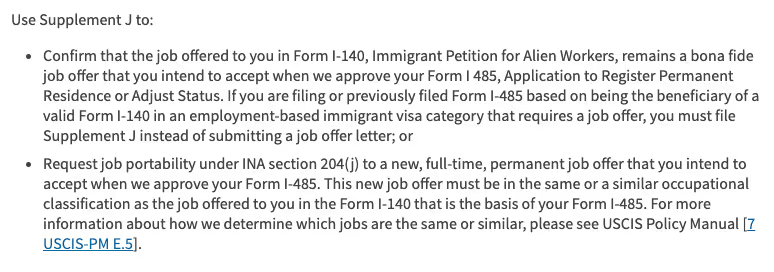
Form I-485 Supplement J, Confirmation of Bona Fide Job Offer or Request for Job Portability Under INA Section 204(j), is required for some employment-based applications. Below you will find additional USCIS information on the use of this supplement.
We’re happy you’re here!
SimpleCitizen is here to help you achieve the American dream. Safely and accurately apply, submit, & stay on top of your immigration status. Let SimpleCitizen guide you through filing Form I-485 and other connected forms. With our easy-to-use platform and expert guidance, filing Form I-485 has never been simpler. Check your eligibility to Form I-485 with SimpleCitizen.
Learn more about what we do, our application assistance timeline, and what customers say about SimpleCitizen’s services.
Do you have a question about SimpleCitizen’s application packages? Let’s chat!
Connected Articles:
What Evidence Must You Provide With Form I-485?
Understanding the Different Paths to Permanent Residency for Marriage-Based Applications
What is an A-Number?
This article aims to provide a clear explanation of what an A-number is and who typically has one.
General Immigration Information
The United States Citizenship and Immigration Services (USCIS) assigns a unique identifier called the Alien Registration Number, A-Number, or USCIS Number to non-citizens who are in the United States and have a lawful immigration status. This A-Number, which is a 7, 8, or 9-digit number, helps USCIS keep track of an individual's immigration history and status. It can be found on important immigration documents such as visas, green cards, and Employment Authorization Documents. So, if you're a non-citizen in the United States, your A-Number is an important identifier that helps ensure your immigration information is accurately tracked and managed.
This article aims to provide a clear and comprehensive explanation of what an A-number is and how to find out if you have one. Whether you are seeking to apply for a visa, green card, or citizenship, understanding the role of A-numbers in the immigration process will help you stay informed and better navigate the complex landscape of U.S. immigration.
Where can I find my A-number?
You can find your Alien Registration Number (A-Number) on several immigration documents, such as:
- Visa Stamp: The A-Number can be located on a visa stamp and is shown as the red number in the lower right-hand corner. If the A-Number on the visa stamp is fewer than 9 digits, a zero is inserted after the “A” and before the first digit to create a 9-digit number.
- Green Card: If you are a lawful permanent resident, your A-Number will be included on the front of your green card. The USCIS# found on a Permanent Resident card is the A-Number .
- Employment Authorization Document (EAD): If you have been authorized to work in the United States, your A-Number will be included on the front of your EAD. The USCIS# found on a Permanent Resident card is the A-Number .
- Check previous communications from USCIS: If you have corresponded with USCIS in the past, your A-Number may be included in any communications you received from the agency. This could include an Immigrant Data Summary, USCIS Immigrant Fee Handout, or Form I-797.
What if I have more than one A-Number?
It's not uncommon for USCIS to issue multiple A-numbers to individuals over time. When completing immigration forms, it's important to list all A-numbers that have been issued. While individuals may have multiple A-numbers, the most recent one issued is typically considered their "primary" A-number and should be used.
Not sure if you have an A-Number?
If you are still determining whether you have an A-Number or need assistance in finding it, you can contact USCIS customer service for assistance. Call 1-800-375-5283 or visit https://www.uscis.gov/ to use their live chat via Ask Emma.
If you are a non-citizen or permanent resident, it is possible and completely normal that you do not have an A-Number, and you can leave that part blank in the immigration forms.
Conclusion:
In conclusion, the Alien Registration Number, A-Number, or USCIS Number is an identifier for non-citizens who are in the United States and have a lawful immigration status. If you have been issued an A-number, it is important to keep track of your A-Number(s) and ensure that it is correctly included on all immigration documents. Doing so helps USCIS track and manage your immigration records. If you are unsure whether or not you have been assigned an A-Number, it is recommended to contact USCIS customer service to inquire about your immigration record.
If you have questions or concerns about your A-Number or any other aspect of your immigration status, we encourage you to reach out to our team of experienced immigration professionals. Our platform provides a comprehensive suite of tools and resources that can help simplify the immigration process and put you on the path to success.
With SimpleCitizen by your side, you can achieve your immigration goals and build a future in the United States. We may be able to help prepare your immigration application! Get started today. We’re happy you’re here!
USCIS Form I-693: Finding a USCIS Doctor and Where and When to Submit Your Medical Exam
USCIS Form I-693: Finding a USCIS Doctor and Where and When to Submit Your Medical Exam
General Immigration Information
The medical exam or Form I-693 (Report of Medical Examination and Vaccination Record) is one of the USCIS-required forms for people looking to apply for a green card/permanent residency in the United States. Since Form I-693 needs to be filled out by a USCIS-approved doctor, there are many things to consider when choosing a doctor. This article will contain basic information for people completing the medical exam from inside the United States.
This article will help answer the following:
- What is a civil surgeon?
- Where can I find a USCIS-approved doctor close to me?
- Things to consider when choosing a civil surgeon
- When should I get my medical exam done?
Please note that the process differs for those completing the medical exam outside the United States. If you are doing your medical examination from outside the US, please visit this link for more information on the correct medical exam process.
What is a civil surgeon?
The USCIS doctors assigned to perform the immigration medical examination are referred to as “civil surgeons.” Only civil surgeons can perform the medical examinations and fill out and seal Form I-693. It is important to remember that unless a doctor is a USCIS-approved civil surgeon and is part of the list of USCIS-approved physicians, they cannot complete Form I-693 or conduct the medical exam.
Where can I find a Civil Surgeon close to me?
If you are applying for a Green Card from inside the United States, you can look for a USCIS-approved doctor (Civil Surgeon) near you using your address, state, or zip code with this link. You can also look up doctors by gender and the language they speak.
Things to consider when choosing a civil surgeon:
There are many things to keep in mind as you determine when and where to complete your medical exam and which civil surgeon to choose. Planning ahead and researching can be very helpful, especially for something as time-sensitive as immigration paperwork. Here are a few things to consider before taking the medical exam:
- Cost of the Medical Exam
USCIS does not require medical offices to charge a set fee for the medical exam. Rather, each medical office gets to determine the fee it will charge for the medical exam. Typically, the exam can cost anywhere between $175 and $900, though it can be much more at some medical offices. For this reason, calling different doctors and shopping around can be helpful. Additionally, please note that medical exam fees doctors charge do not usually include the cost of vaccinations that applicants may need. Some doctors can provide the necessary vaccinations in-office, so be sure to contact a USCIS civil surgeon for more information.
For a list of the vaccines required by USCIS, click here.
- Wait times
Wait times for the medical exam vary and are subject to the availability of the civil surgeon you choose. While some offices are available within a week of scheduling, others may have long delays. Usually, the cheapest medical offices have the longest wait times. This is another reason why it can be helpful to consult multiple doctors when possible. While the medical exam can be a relatively short interaction with the doctor, it is not unusual for it to take two weeks or more for the doctor’s office to complete the required paperwork and mail it to the applicant. This wait time is often impacted by needed vaccinations.
Any Form I-693 that was properly completed and signed by a civil surgeon on or after November 1, 2023, does not expire and can be used indefinitely as evidence to show that the applicant is not inadmissible on health-related grounds. USCIS officers have the discretion to request more evidence or a new or updated Form I-693 if they have reason to believe the applicant’s medical condition has changed since the civil surgeon signed the Form I-693, or that the Form I-693 submitted does not accurately reflect the applicant’s medical condition and the applicant may be inadmissible on health-related grounds. Medical exams completed before November 1, 2023, have a 2-year validity period.
- Location
As listed above, you can find your closest doctor using this link and your zip code. Please note that the number of civil surgeons available varies by state and location. Planning ahead can be helpful, as some people may be required to travel long distances to complete this exam.
- Reviews
There are several ways people can find a doctor that they are comfortable with. Many civil surgeons have reviews on Google that discuss other patients’ experiences. Also, through the USCIS “Find a Civil Surgeon” link, a person can filter doctors by gender and by the language they speak. People can use reviews and these filters to look for options they trust.
When should I get my medical exam done?
While USCIS previously allowed Form I-485 to be submitted without a complete Form I-693, Report of Immigration Medical Examination and Vaccination Record, they changed that rule as of December 2, 2024, and now require that adjustment of status applicants submit the medical exam at the time of submission of Form I-485.
For applicants who are required to submit Form I-693 or a partial Form I-693 (such as the Vaccination Record for applicants who entered on K visas), USCIS will reject Form I-485 if the completed medical exam is not submitted concurrently with Form I-485, Application to Register Permanent Residence or Adjust Status.
TRANSLATION OF VACCINATION RECORDS:
Some offices require applicants to translate their vaccination records. In some cases, when the USCIS civil surgeon speaks the applicant’s native language, translations may not be needed. However, this can vary from office to office. Please make sure to call and check with the USCIS doctor to determine what documents are translations are needed.
Conclusion
USCIS requires the medical examination (Form I-693) for all people filing for a green card. A USCIS-approved doctor (civil surgeon) must perform the exam and complete the form. The exam can then be submitted with the application or at the moment of the USCIS interview. Please consider the vaccines needed, wait times, and availability of doctor’s offices before scheduling an appointment. It is also important to note that the current USCIS requirement is to send the medical exam with the application. If you have any questions about your medical exam, please feel free to reach out to our live chat or call your Civil Surgeon.
Please visit this article for more information on what to bring to your medical examination, what happens at the exam, and how to send the form.
SimpleCitizen would love to help you with your immigration case!
To sign up now, click here.