
General Immigration Information
Learn more about visas, immigration best-practices, and other helpful information!
Michelle: My Immigration Story
Read to learn more about Michelle's Immigration Story.
Last Updated: January 15, 2020.
The journey began in Mexico right before Christmas. My mother picked me and my sister up early from school one day. I remember my sister and I were overjoyed to see her because she was usually busy with work and didn't have time to pick us up from school. I was only seven years old then, and I had no idea my life was about to change forever. Everything seemed normal as I packed a small backpack when I got home, and I still didn't know we were leaving when my mother gave me and my sister and early Christmas present that night right before we boarded a Greyhound bus. I think it all started to sink in when I arrived in Utah and I saw the snow falling. I had never seen snow before. It was cold but I ran around trying to catch it as it fell in flurries to the ground. We were in America now, and we were going to make it our home.

My first challenge was learning English. The kids at my elementary school crowded around me during recess and lunch and kept trying to get me to talk to them. They would hold up basketballs, or point at chairs and ask me questions. I had no idea what they wanted, and the professors didn't know what I needed either. I would often make gestures to get permission to go to the bathroom, or mimic what I heard my classmates say even if I had no idea what the words meant. My mother was having similar problems. She walked up and down the grocery store aisles not knowing what kind of food she was getting or what the cashier was telling her. It got worse when my sister and I began speaking our school learned English at home, which wasn't very good, but much more advanced than the English my mother spoke. My mother had no idea what we were saying to each other. That was when she decided we all had to learn to speak, read, and write English. She signed me and my sister up for a special reading class during the school year and a summer reading program. My mother also began volunteering at our local library and joined me and my sister when we attended the library activities. She did reading and writing homework with us and would go out of her way to speak English with whoever would listen. She even joined the PTA of my elementary school to practice her speaking with my teachers and peers. She did this for years, and I remember my mom gave a lesson to my technology class when I was in jr. high. She still spoke with a heavy accent, but her reading and writing skills were as strong as mine by that time, and she understood English just as well.

I was about fourteen years old when my mother got remarried, but it was not until I was in high school that we began thinking seriously about getting our green cards. Up until then, we had been undocumented and hadn't thought much of changing our legal status, but I was starting to think about furthering my education and realized that I didn't have a social security number and could not apply for admittance to universities or for loans to help me pay tuition. Without a green card, my education would end after high school not because I didn't want to study, but because I couldn't apply. I discussed my worries with my mother. She listened and decided that it was time to get our green cards.
My mother began asking her friends for help. Most of them told her to look it up online. When she ran a search for green cards a huge list of attorneys came up. All of them were asking for high amounts of fees to fill out forms and get appointments. The prices ranged from 400-1500 dollars just to start the applications. We didn't have that kind of money. My mother was a cleaning lady and we hardly had enough to make it from month to month. There was no way we could hire an attorney. She told me and my sister about how hopeless it all seemed as she drove us home from school one day, and we all got scared and I began to cancel all of my plans to further my education. This broke my mother's heart. She didn't come all the way to America for us to give up. We had to find a way to obtain our green cards and eventually citizenship.
My mother found a Hispanic center close to our home and it was there that she found out about the USCIS.gov website. It was free and had instructions on what forms to fill, documents to gather, and steps to take in order to get a green card. While my sister and I went to school she went to the library and the computer there to read the instructions and print forms. If she didn't understand something she would get a library assistant to help. She also called and visited the USCIS field office and visited the local Hispanic Center frequently for more complicated questions. She had to gather her previous divorce papers, all of our birth certificates, passports, and other documents that were listed in the instructions. What I remember the most was when we all had to get our vaccinations up to date. My sister and I only had to get the tuberculosis test because we had been going to school and needed to get shots regularly, but my mother had to get almost seven shots in one doctor's visit. We also visited the Mexican Consulate to gather documents and have more questions cleared up. I remember that every Sunday my mother would sit on her bed and fill out forms and put together folders. Sometimes I sat on the bed and helped her out.
Overall, it took us two years to gather everything we needed. We each had our own folder stuffed with forms and documents. We mailed them in and waited. We were afraid and one time my mother sat me and my sister down and explained that because we had been undocumented for some years, there was a small chance that we might get deported for a year before we got our green cards, but that we should not be afraid. After six months we got the letters for our interviews. Our cases had been processed and if we did well in the interview we would get out green cards. We woke up early, dressed up in our nicest clothes, and did our hair. We arrived at the time we were scheduled and waited in a large room filled with chairs. A few others were in the waiting room with us, all looking as nice and nervous as us. We waited for two hours before they called us in. My mother, step-father, sister, and I walked in. The room was a small and very short man with glasses sat at the other side of a desk. He called us all by name to make sure we were all present. He looked at my mother and said, "Everything looks ok. We have all of your documents." We all smiled, and I remember I clutched my hands tightly together on my lap. He continued his speech. "I just have one question for you. Do you have any kind of proof that you all do things as a family? Do you have family passes or memberships to parks or events that you can show me?" We all looked at each other. We went to the movies every weekend, went swimming, had dinner together, and went to church but we had no way of proving it. My mother thought for a minute and then opened up her wallet. She pulled out a membership for the Clark Planetarium in Salt Lake City. My step-father, sister, and I followed her lead and pulled out our memberships too. The man smiled. "Alright. Congratulations," he said, and we all took a sigh of relief. My mother almost began to cry and she asked the man if she could give him a hug. He politely denied and shook all of our hands instead. We all hugged each other when we reached the parking lot and laughed and decided to go out to dinner to celebrate and we smiled and celebrated again when our green cards arrived in the mail a couple of months later. All the time, effort, and persistence paid off and my mother, sister, and I were finally permanent residents of the United States.
That victory was seven years ago, and thanks to my mother's hard work I am now about to graduate from Brigham Young University and my sister has a good job and has bought a house with her new husband. Currently, we are all going through the process of getting our citizenship. This has been much easier. Again, my mother has done all the work herself with the help of the USCIS.gov website. Since we are all adults now, we were able to work and save money to pay the necessary fees in about a year. Just the other day we all received our appointments for our interviews where we will turn in our green cards and be sworn in. My sister and I don't have to take a government or language test because we went through the public school system, but my mother got a list of books to get so she can begin studying for her exams. The books are inexpensive and she is excited to look over them and study when they arrive in a couple of weeks. Again, we are all a bit nervous but we are also relieved that we were able to get this far with free resources and hard work.
Best Non-Profits for Immigration Help
Nonprofits that have proven results in facilitating a better experience for immigrants in the US.
Last Updated: January 15, 2025
Here at SimpleCitizen we provide immigrants with tools and expertise in order to make your status goals here achievable. Of course there many organizations that recognize the value of welcoming those that share the American dream. In order to give you the necessary tools to accomplish you goals, here are descriptions of nonprofits that have proven results in facilitating a better experience for immigrants of America.
In no particular order...
Refugees
International Rescue Committee - Better Aid
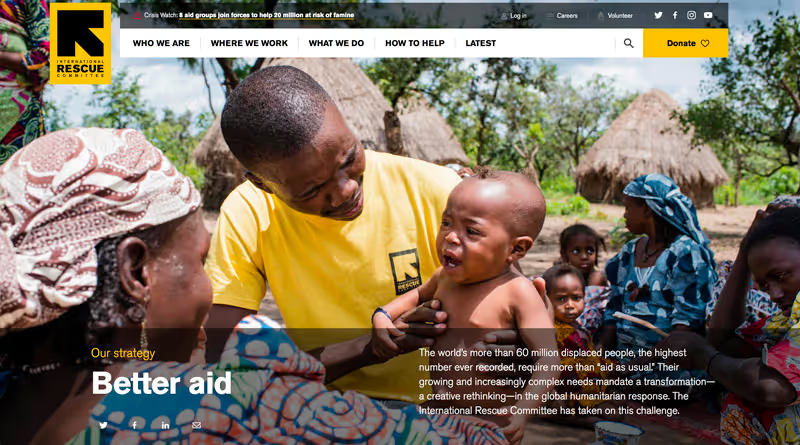
The world’s more than 60 million displaced people, the highest number ever recorded, require more than “aid as usual.” Their growing and increasingly complex needs mandate a transformation—a creative rethinking—in the global humanitarian response. The International Rescue Committee has taken on this challenge.[/caption]
The IRC works all around the world with a wide variety of issues, in the United States alone the IRC helped resettle 13,400 refugees in 2016. They have a very holistic approach to resettlement, primarily focused on immigrants that are fleeing a crisis. The IRC was started 80 years ago by Albert Einstein, whose genius seems to have penetrated the organization to this day. Fast Company claims that "...none that can rival its ability to help refugees and displaced people at every stage, from emergency response to resettlement..."
With such a wide variety of help across the entire nation, the IRC is one of the top resources for refugees. You can get the contact info of branches all over the world here. It'd be impossible to go over all the services they offer in this article, but you can take a look at what they do in Education, Health, Economic Wellbeing, Empowerment, Safety and Gender equality on their website. Did we mention they have a very holistic approach? And if you want to join the cause, they also have a variety of volunteer and internship opportunities.
Deportation
For those threatened by deportation it can feel like such a life-changing event is completely out of your hands. Both United We Dream and Families for Freedom are committed to giving immigrants the tools to empower those in the face of deportation.
United We Dream - Immigrant youth building a movement for justice
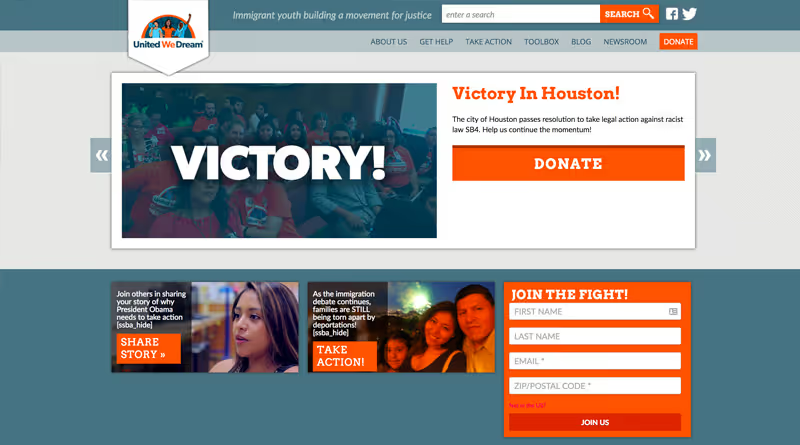
Over 100,000 immigrant youth and allies. Fifty-five affiliate organizations. Twenty-six states. Oh, and its a youth-led organization. United We Dream has a huge network that they use to run immigrant-related political campaigns like stopping deportations and access to higher education. They have even branched into the "intersection of queer and immigrant rights." If any of these issues are relevant to you, then you can Get Help! You can also find a local group to participate in here.
Whether there is a local group near you or not, United We Dream has provided a Toolkit to help immigrants all over America. Their website includes an ICE activity reporting hotline as well as Deportation Defense Cards that you can download in multiple languages. They recommend that if you feel threatened by deportation to keep the card with you at all times.
Families for Freedom - "As long as deportations and unjust immigration policies continue we will continue to fight to keep our families together"
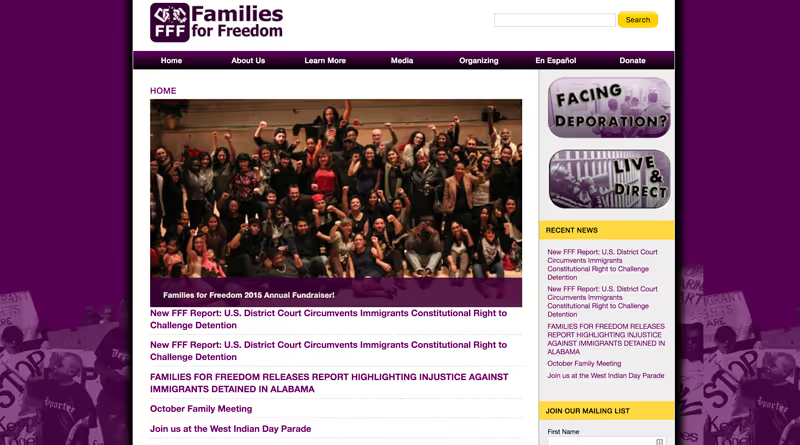
Founded in September 2002, Families for Freedom is a New York-based multi-ethnic human rights organization by and for families facing and fighting deportation.[/caption]
FFF started in response to the persecution to the often unmentioned victims of 9/11, when the wave of fear that followed one of America's greatest tragedies became directed to innocent Arabs and Muslims. FFF started with three families in a small apartment, you can read their powerful story on their The History of Families for Freedom page. Although initially FFF was focused on helping Arabs and Muslims, they have since expanded their net to include all immigrants. Like United We Dream, FFF has resources for understanding deportation threats, how to behave when your are threatened by deportation, understanding your rights, and a deportation hotline as well.
Both of these nonprofits are a powerful example of grassroots mobility and the power that average people with with a unified cause. If you feel threatened by deportation, start becoming familiar with their tools today.
Community Resources and Integration
Moving into new communities as an immigrant is full of challenges. Welcoming America and the U.S. Committee for Refugees and Immigrants use their vast network to support immigrants and the organizations that want to greet them in America.
Welcoming America - Building a Nation of Neighbors

Welcoming America began after founder David Lubelli's method for transforming the community mindset in Nashville began being copied other parts of the country. After realizing the potential of the the strategy he had implemented, David first went to Harvard for a year to study policy and social psychology, and to perfect his method. Then came Welcoming America, a platform to make the communities more "fertile" for welcoming immigrants. David recently got the Charles Bronfman Prize, and you can be rest assured any organization found on their Network Map will have been trained to fully support your integration in the community.
U.S. Committee for Refugees and Immigrants

Founded in 1911, the U.S. Committee for Refugees and Immigrants has deep roots in watching over vulnerable immigrant communities. Their rich history and commitment to providing homes for the needy has made them a leader in determining what needs to be facilitated to help immigrants be successful in America. This makes both the Committee's own offices and their partners a trusted resource. For the four offices in New York, Iowa, Virginia, and North Carolina, some of the services they provide include:
- Naturalization
- Asylum
- Special Immigrant Juvenile Status (SIJS)
- Family-based Immigration Petitions/Applications
- Consular Processing
- Adjustment of Status Applications
- Work Authorization
- Green Card Renewal Applications
- Self-Petitions for Battered Spouses and Children (VAWA)
- Temporary Protected Status (TPS)
- T Visa (victims of human trafficking)
- U Visa (victims of crime)
- Removal of Conditions to Permanent Resident Status
- Removal Proceedings
Of course their network of 97 partner organizations is another valuable asset. You can view their agency map here.
Immigrant Rights
American Immigration Council - Honoring our Immigrant Past, Shaping our Immigrant Future
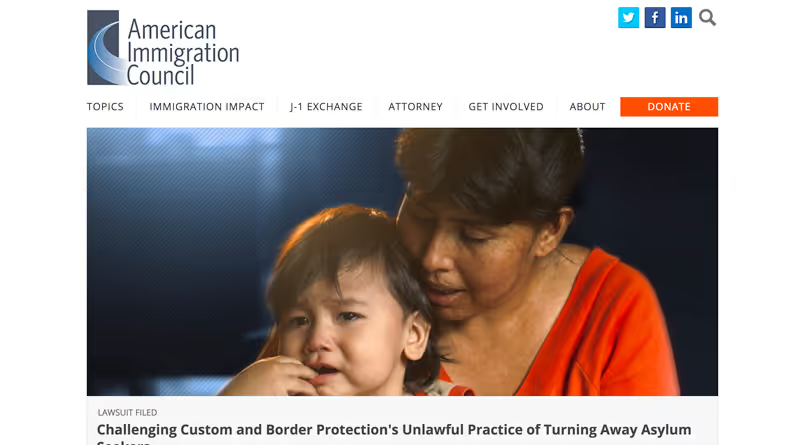
Shaping our immigrant future.
Hopefully you will never need the American Immigration Council's direct services. As one of the heavy hitters among immigration litigation, they deal in the most critical immigration cases that shapes how the country interprets immigration law. In fact, they are so important that they will never resort to shortening their name in an acronym, instead referring to themselves as "the Council."
The Council has done a lot of good for the rights of immigrants. They are a nationwide fearless defender of fair interpretation of the law. When government agencies neglect or oppose their duty to uphold immigrant rights, the council will not hold back punches. You can read a Washington Post article about the Council's law suit against top U.S. officials including Homeland Security Secretary John F. Kelly here. In a time where the norms of government are being disrupted left and right, the American Immigration Council serves as a nonpartisan advocate for respect and accountability in immigration law.
In addition, the Council provides of valuable research to inform the public with their website http://immigrationimpact.com. It's a great resource for staying up-to-date on immigration news and developing issues. In their own words "The Council is a national leader in challenging the myths and misinformation that too often dominate the political and public debate around immigration." Finally, the Council has an Exchange Visitor Program which utilizes the J Visa sponsorship to enhance and promote cultural exchange.
Benefits
Immi - Understanding Your Options
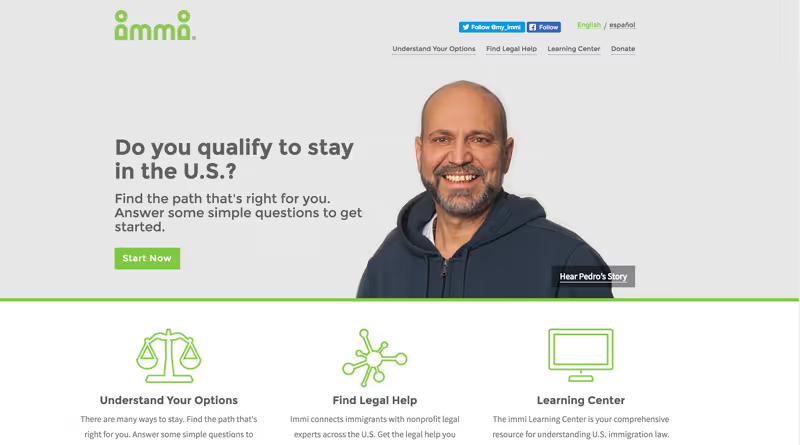
Do you qualify to stay in the U.S.? - Find the path that's right for you. Answer some simple questions to get started.[/caption]
Little know secret, being informed about your immigration options is complicated.
Ok maybe that's not a secret, and maybe it doesn't have to be complicated.
Immi's somewhat clunky slogan tells you exactly what they do. However, their online screening tool is more like the name of this innovative nonprofit - user-friendly and techy. Immi's online screening tool allows immigrants to easily gain a better understanding of their legal options. After completing the survey, your results are sent to your phone or email. Imagine, 1.5 million undocumented immigrants having access to a tool that explains what benefits they are personally eligible for.
In addition, despite being less than a year old, Immi's has one of the best immigration Learning Centers and Legal Help directories, both powered by the vast data and experience of its two parent organizations: Immigration Advocate Network and probono.net. These two organizations have partnered before on several projects, and their past working relationship allowed them to respond with serendipitous timing to the sense of urgency catalyzed by American political rhetoric.
Local organizations can be found by Immi's Legal Help tool, which provides a user-friendly search engine to find helpful organizations nearby, primarily with legal help. In addition to filtering by location, you can also narrow your search by organizations that provide the specific services you need (including non-legal), populations served and other relevant criteria. Rest assured, all non-profits found at Immi have been recognized by the Board of Immigration Appeals (BIA), or at least have staff that are included in their directory.
Honorable Mentions
HAIS
HAIS has study guides for citizen test available and subtitled prep videos in six languages: Arabic Nepali, Serbo-Crotiaon/Bosnian, Somali, Spanish, Vietnamese
Americans for Immigration Justice
A unique combination of free direct services, impact litigation, policy reform, and public education at local, state, and national levels.
Upwardly Global
They work with skilled immigrants to find employment in the United States
The Young Center
This organization upholds immigrant child rights, they have a referral function on their page if you know of an immgrant child that could use their services
What to do if you have lost your Passport
For information on how to replace your passport and visa, follow the steps outlined below.
Passports and visas are official travel documents that all foreign citizens coming to the United States must have to show one's country of citizenship and legal status in the U.S., as well as to enter and leave the country. Losing these important documents can be very stressful - here's a short guide to help relieve some of that stress and move forward.
First of all, don't worry. Your visa is needed only to enter the United States; it has no relevance to your stay here after entry. In other words, if you happen to lose your visa while already in the country, you may remain the entire length of your authorized stay (as shown on your admission stamp or Form I-94, Arrival/Departure Record) without any problems. You will, however, need a valid passport to depart the United States and enter another country. For information on how to replace your passport and visa, follow the steps outlined below.
Search
Make sure your passport/visa are actually lost and not just misplaced. Search your home, luggage, wallet/purse, and anywhere else you may have stored them. Ask family members and travel partners if they have any knowledge of the documents' location.
File a Police Report
If you still cannot find your passport/visa, go to your local police station and report your document(s) lost or stolen. If you have copies of the original documents, bring them with you. You will then be issued a police report detailing the incident. Make a copy of the report for your own records.
Report Loss of Your Passport
Contact or visit your country's embassy or consulate in the U.S. to notify them of your missing passport and for instructions on how to obtain a new one. If you think your passport has been stolen, reporting this will help guard against fraudulent use. It is extremely important that you perform a thorough search before you report it lost or stolen, because once reported, your passport is no longer valid for travel. However, if you find your passport after having reported it lost or stolen, it may still be used as a valid form of personal identification.
- If you do not have another form of photo identification, contact your country's embassy/consulate to find out what alternate documents you may need.
Report Loss of Your Visa
To report your visa lost or stolen, email the U.S. Embassy or Consulate outside the United States that issued your visa. Go to the U.S. Embassy or Consulate website to locate the corresponding email address and contact information. Be sure to include your full name, date and place of birth, current address in the United States, and your email address. Clarify whether your visa was lost or stolen, and if you have a copy of it include it in the email. If you know the category of visa you have or your passport number, include these too.
Like your passport, if you have already reported your visa as lost or stolen to the U.S. Embassy or Consulate but later find it, your visa will be invalid for future use, and you will have to apply for a new one.
Applying for a Replacement U.S. Visa
For future travel into the United States, you will need a new visa. Unfortunately, lost or stolen visas cannot be replaced in the United States. For replacement, you must apply in person at a U.S. Embassy or Consulate abroad. When you apply for a visa replacement, you will need:
- A written account documenting the loss of your passport and visa
- A copy of the police report
A Few Things to Keep in Mind
- Again, you won't have any problems remaining as long as originally authorized, but you will need a new passport before you return home. The replacement process can take time, so begin as soon as possible to ensure that you have a new one in time for your return trip.
- Some embassies and consulates may offer faster processing procedures, so ask if them if there is a way to process the new passport quickly.
- Traveling while you wait for your new passport can be risky, so try to postpone travel plans until you receive your new passport.
- If you need to complete an I-9 for employment (employment verification form), wait until you have your new passport before processing the form.
One Last Tip
We recommend making copies of all travel documents in your possession as soon as possible after arriving in the United States. These include your passport biographic page, visa, and admission stamp or Form I-94. That way, if you do lose one or all of these important documents, the recovery/replacement process will be that much easier. Remember to stay calm, follow the procedures outlined here, and respond to all questions and embassy/consulate employees honestly and accurately - before you know it, you'll be along your way as if nothing ever happened. Safe travels!
What happens at the Biometrics Appointment?
An overview of what to expect during your USCIS biometrics Appointment.
Last Updated: January 15, 2020.
The biometrics appointment sounds technical and is often intimidating for people, but it's usually a very straight-forward appointment! In order to confirm your unique identity, the USCIS collects data for many reasons, one is to ensure that whenever YOU sign a document in the future, it really is you! It also helps deter people with criminal records from applying for USCIS benefits for which they are not eligible. Here are some of the most common questions about the appointment, as well as some common problems and how to prepare for them.
What exactly does “biometrics” mean?
Biometrics is the process of capturing your unique features by putting your fingerprints, photograph, and signature on file so that the USCIS can confirm your identity in the future.
Who has to attend the biometrics appointment?
The USCIS can require biometrics from any applicant, sponsor, or beneficiary living in the US for any immigration or naturalization purposes. After filing your application, petition, or request you will receive a notice telling you where and when you need to go for the appointment.
If you are under the age of 14, you may choose to sign if you are able to, or a parent or legal guardian may sign on your behalf.
How should I prepare for the biometrics appointment?
It is a good idea to make copies of your application, petition, or request. You may bring a copy (as the USCIS will not provide you with one), but you should also do this to keep for your records and to review your forms before the appointment. Your personal appointment notice will include specific instructions on what you need to bring. Everyone MUST bring the ASC appointment notice (Form I-797C) and a valid photo ID (like a green card, passport, or driver’s license).
For most people, the biometrics appointment is nothing to be worried about! If you think you have a criminal background, you may want to contact a lawyer for further advice.
What should I expect at the biometrics appointment?
You will first be asked to reaffirm the following “Acknowledgement of Appointment at USCIS Application Support Center” statement:
I declare under penalty of perjury that I have reviewed and understand my application, petition, or request as identified by the receipt number displayed on the screen above, and all supporting documents, applications, petitions, or requests filed with my application, petition, or request that I (or my attorney or accredited representative) filed with USCIS, and that all of the information in these materials is complete, true, and correct.
If you cannot reaffirm that this is true, your appointment will be rescheduled until you can refile your paperwork.
Given that everything you submitted was true, the USCIS will capture your fingerprints (either 2 or all 10, depending on the type of ASC notice you received), your photograph, and your digital signature.
What if I am applying from outside the United States?
The process is a bit different in this case. When you file your Application for Naturalization (Form N-400) you have to include your completed fingerprint cards (Form FD-258) and two passport style pictures. For specific instructions and details regarding those, look here and here, respectively.
If you are active duty military or are applying under sections 328 or 329 of the Immigration and Nationality Act and you live outside the U.S., look here for more information.
What if I require assistance?
Many people require assistance for the appointment. Here are some of the common issues people may have, and the solutions provides by the USCIS to make this process as easy as possible.
Common Concerns
I can’t speak English.
You may bring someone with you who can translate for you.
I can’t read English.
For the “Acknowledgment of Appointment” statement, you should go here to select the language you can read and review the translation before your appointment.
I have a disability that prevents me from signing my name.
They will accept any mark (such as an “X”) as a signature. If you cannot provide this, there are other procedures in place to capture your biometrics.
I have a disability that will require further assistance.
You may bring a family member, attorney, or accredited representative to assist you.
I have a disability that will require further accommodation.
As soon as you arrive you should speak to the ASC immigration services officer for help. There are tons of accommodation services available, but you will likely need to request them in person. You can also try contacting your local Application Support Center before the appointment. Their contact information should be on your appointment notice.
Why might I have additional biometrics appointments?
Because biometrics data is only considered valid for 15 months, you may be required to attend more than one if your application is pending for longer than 15 months. You will also have to attend a new appointment should you apply for a different USCIS benefit.
What if I am uncomfortable with the government having my fingerprints and other personal data?
Unfortunately, if you refuse to provide anything that is asked of you during the biometrics appointment, your application will more than likely be refused. Biometrics are being used increasingly around the world and seem only to be gaining popularity by international law enforcement and immigration services, so you will likely be asked to provide similar levels of data to obtain a visa or green card in most countries.
Request for Evidence (RFE)? What To Do
What is a Request for Evidence and what does getting a letter of Request for Evidence mean for you?
Updated: October 1, 2021
What is a "Request for Evidence?"
What is a Request for Evidence and what does getting a letter of Request for Evidence mean for your application?
The letter means USCIS needs more information to process your application. RFEs are fairly common but are serious in nature. They must be responded to in order to keep your application on track. But don't worry, getting an RFE does not mean your case is denied and preparing a response can be fairly simple. Keep reading to learn what to do if you receive an RFE.
What happens if I get a Request for Evidence?
USCIS will send a letter to the address you've provided that explains what additional information they need from you in order to move forward with your case. For tips to avoid an RFE click here.
The RFE will have a deadline. You must respond by the deadline. This deadline is usually in the first paragraph and in BOLD. The typical time to respond is about 87 days, but USCIS will sometimes give a specific date or timeframe for you to respond.
Example: An RFE may say something like, “you must submit the information within 87 days”. Treat this timeline seriously and do not delay submitting the necessary information or evidence that they are requesting.
When you are getting ready to send in the requested information indicated in the RFE, make sure to review the letter carefully. You must respond to all information requested at one time. USCIS will not allow you to send more evidence later. You only get one response. Make sure that you attach a cover letter explaining what you are sending in, why you are sending it in and any other information that might be helpful.
The RFE will include instructions for where to send the response. In some cases you'll need to include the original RFE letter with your response, while in other cases USCIS only requests a copy of the RFE letter. Whether you are required to send the original or the copy, attach it to the very top of your response. Make sure that it is the first page and the first thing that the USCIS officer sees when they open your application.
The RFE should include an address for you to send the response packet to. Make sure that you send the RFE response to the address listed. It will be different than the original USCIS address that you sent your application to.
Let us know
Immigration issues can be tricky. If you have any questions about your specific Request for Evidence or your immigration case, there are experienced professionals that can help.
If you are a customer of SimpleCitizen and you've received an RFE please reach out to us via live chat, email or phone. RFE responses are included with the Professional package we offer. Do not hesitate to reach out and ask for help.
What Happens After Submitting the Form I-130?
Understanding the steps that follow after submitting Form I-130.
Last Updated Jan 15, 2020.
The I-130, Petition for Alien Relative, is the first form you must submit in order to obtain lawful permanent residence (green card) for a family member. After submitting this form, there are three key steps which must occur to receive a green card:
1. Confirmed Receipt of I-130
Within 2-3 weeks of submitting your I-130, you should receive a Notice of Action (also known as Form I-797). It is vital that you read the information on this notice, as it will tell you if your I-130 has been received, rejected, or requires more information from you. The Notice of Action will contain a priority date and a receipt number can be used to check application status.
If you haven't received a Notice of Action within a few weeks, you should make an inquiry here.
2. Approval Process of I-130
After your I-130 is received, it will be reviewed. USCIS prioritizes the review of petitions from Immediate Relatives, which comprise:
- spouses of citizens
- unmarried children (under age 21) of citizens
- parents of citizens 21 years of age or older.
USCIS issues an unlimited number of immigrant visas (green cards) to Immediate Relatives. Thus, processing time is faster for Immediate Relatives than other relatives.
Other relatives are categorized as Family Preferences:
- Unmarried children of U.S. citizens age 21+, and their minor children (F1)
- Spouses, minors and unmarried children age 21+ (F2)
- Married children of U.S. citizens, their spouses and minor children. (F3)
- Siblings of U.S. citizens, and their spouses and minor children, if age 21+ (F4)
Congress permits a limited number of Family Preference visas per year. Therefore, people who fall into this category often wait longer for a visa number to become available. Priority depends on when the I-130 was submitted. The wait time can be anywhere from 6 months to 6 or more years.
3. Filing for a Green Card
Once your I-130 is approved, you may be permitted to file for a green card and hopefully obtain lawful permanent residence. The filing process depends on relative status and where you are currently living.
Immediate Relatives:
- Inside the US: Immediate relatives inside the US can submit Form I-485 (Application to Register Permanent Residence or Adjust Status) while the U.S. citizen petitioner files Form I-130. Relatives may file I-485 applications any time after a Form I-130 has been submitted if it has not been denied, although relatives must submit a copy of their Notice of Action along with Form I-485 in order to prove that Form I-130 is in process.
- Outside the US: Immediate relatives outside the US obtain green cards through consular processing. The USCIS will work to schedule a visa interview with a U.S. consulate in the relative's country. The Department of State will notify the relative when he or she is may apply for an immigrant visa, which must be applied for within one year of this notification. Once the Department of State issues an immigrant visa, the relative may travel using the visa and will obtain permanent residency when they reach a U.S. port of entry.
[eligibility-quiz-green-card]
Family Preference:
- Inside the US: Once Form I-130, Petition for Alien Relative, is approved, one must wait for the priority date in one's immigrant visa category to become current (see the date listed in the Notice of Action, and check when it is current by adjusting the following June 2017 URL to reflect the current month and year uscis.gov/visabulletin-Jun-2017). When the date listed is current, it is time to file Form I-485, Application to Register Permanent Residence or Adjust Status. This is the required form for becoming a Permanent Resident.
- Outside the US: Family Preference relatives outside the US also obtain green cards through consular processing. See those details above.
Remember...
- In most cases, children's ages are “frozen” as the ages listed when Form I-130 was filed.
- If unmarried children of U.S. citizens get married before obtaining green cards, they may cause serious delays in processing. Children of U.S. citizens must notify USCIS of any change in marital status after submitting Form I-130.
What Happens After Filing Form I-90?
Understanding some of the steps that following submitting Form I-90 to USCIS
Last Updated: January 15, 2020.
You've just submitted your Form I-90, but you are curious what happens after submitting your form I-90. There are just a few more steps before actually receiving your new green card. Depending on the current USCIS wait times, you can expect to receive your new green card about 6-12 months after submitting your I-90. This guide outlines the post-application process, making it smooth and stress-free.
1. Receipt of Application
The first thing that will happen after submitting your I-90 is you will receive a Receipt of Application from the USCIS aka Form I-797C, Notice of Action usually takes up to 3 weeks to arrive. This means the USCIS has received your application. If the USCIS needs more information or your application has a mistake, the I-797 may have additional instructions. Follow the instructions in these letters carefully.
2. Appointment Notice
The appointment notice informs you when and where to go for your Biometrics appointment. The purpose of the Biometrics appointment is simply for the USCIS to confirm your identity and run a standard background and security check. Save the appointment notice because you will need to bring it with you along with a valid photo identification. This could be a green card, drivers license, passport or a national photo identification issued by your country. It could also be a military photo identification or other state-issued photo id card.
*Note: Its also good idea to bring a copy of your application, because they cannot provide you with one at the regional USCIS office.
3. The Biometrics Appointment
As mentioned above, the date, time and location of the Biometrics appointment will be mailed to you in the Appointment Notice. Show up to scan your fingers, sign an attestation and have a photo taken. It takes most people only 15-30 minutes.
Digital Signature
- Be ready to sign an attestation that reaffirms that on the application you provide correct information (at the time of filing). The only exceptions apply to those with certain physical impairments or mental disabilities. Otherwise you must sign. You can read more about this process here.
- If you would like, you may bring an attorney, interpreter, family or friend to stay with you throughout the process. However, even if your attorney prepared your paperwork, they are not required to attend your biometrics appointment.
Rescheduling
If you need to reschedule follow the directions in your Appointment Notice as soon as possible. If the biometric information is not fulfilled soon enough your application will be at risk of denial. After you've made a reschedule request, the regional USCIS office will assign you another date within 30 days of your reschedule request.
4. The Finish Line
Generally, the whole process takes about 6 months. If you are getting nervous you can always check the status of your application here using your application receipt number.
When your application is accepted your green card will be mailed to the U.S. address you gave the USCIS in your application. You'll also get a letter if your application was denied explaining the reason for its denial. There are two ways to get another chance if your application is denied.
- Motion to Reopen - if you have new evidence that you want the USCIS to consider with your application.
- Motion to Reconsider - this motion is if your application's denial was incongruent to law or immigration policy. This must be established based around the information that you have already submitted.
Note: You cannot file an appeal regarding your I-90 application. Meaning that there is not a way to request a higher authority to review the decision. It will be the same office that reopens or reconsiders your application.
Other Resources
- USCIS National Customer Service Center (NCSC): 1-800-375-5283. Have specific information about your application ready, including your receipt number, Alien Registration Number, name and date of birth.
- Find accredited legal help here.
- Locate an USCIS office here.
- For more information about the green card renewal process, click here.
SimpleCitizen makes software that simplifies the green card renewal process. We’ll guide you through every step of the application, and you can even have it reviewed by a professional immigration attorney. When you’re finished, we can even print out the forms and mail them to you. To get started, click here.
Undocumented to Green Card: The Real Story
Get to know Vikram Babu and the story of his journey to obtaining a green card!
Last Updated: January 15, 2020.
Medium.com featured the tell-all, behind the scenes tale of one mans struggles through life and the intimidating US immigration process.
Vikram Babu tells his story of going from Indian immigrant to Canada to undocumented alien in the US to full-fledged green card holder. His story mirrors the same plot points of millions of other families in the U.S. that find a pathway to citizenship via the green card program.
He tells the beautiful story of love found, then love lost. The mini-challenges of learning the difference between a Form I-130, Form I-485, supporting documents and the Form G-325A. A natural Do-It-Yourself inclined man, Vikram spent months putting the application together himself, following the instructions carefully. This process can be very stressful as millions of immigrants end up paying lawyers billions of dollars every year to avoid rejections or delays by the government due to a simple mistake on their application.
Vikram explains the feeling of relief as he successfully completes the green card process with the USCIS. As he establishes himself, makes progress in his career, moves to a new city, he is struggling with the same challenges that everyone faces as we navigate life, US citizen or not. He deals with the added difficulties of the anti-immigration sentiment that existed in 2009-2012 and continues on today.
Vikram's story is particularly important because most American citizens have a similar story in their family be it from their grandfather, great-grandmother or beyond. These immigration stories are not only important moments in the lives of each of these families, they have also been important moments in the story of America.
Read the entire story (10 min read) with pictures via Medium.com here
Where do you Send Form I-130?
This article outlines where to submit Form I-130.
Last Updated: June 6, 2025.
Once you have filled out Form I-130 and gathered all supporting documentation, you’re ready to send it in to USCIS! But where you send the form is different depending on where you live and whether or not you are filing Form I-130 with any other forms.
Please be aware that USCIS updates this information frequently, so be sure to check the USCIS Form I-130 Direct Filing Address page for the most up-to-date mailing information. If you are filing Form I-130 concurrently (at the same time) as Form I-485, please defer to the USCIS Form I-485 Direct Filing Address page instead.
USCIS Phoenix Lockbox Facility
If you live in any of the following states or territories, and are ONLY filing Form I-130, you will send your Form to the USCIS Phoenix Lockbox facility.
- Alaska
- American Samoa
- Arizona
- California
- Colorado
- The Commonwealth of the Northern Mariana Islands
- Florida
- Guam
- Hawaii
- Idaho
- Kansas
- Montana
- Nebraska
- Nevada
- New Mexico
- North Dakota
- Oklahoma
- Oregon
- Puerto Rico
- South Dakota
- Texas
- Utah
- Virgin Islands
- Washington
- Wyoming
If you are sending the form through the U.S. Postal Service (USPS), please address the envelope:
USCIS
Attn: I-130
P.O. Box 21700
Phoenix, AZ 85036-1700
If you are sending the form through Express mail or through a commercial courier, please address the envelope:
USCIS
Attn: I-130 (Box 21700)
2108 E. Elliot Rd.
Tempe, AZ 85284-1806
USCIS Elgin Lockbox Facility
If you are only filing Form I-130 and live in any of the following states or territories, you will send the form to the USCIS Elgin Lockbox facility:
- Alabama
- Arkansas
- Armed Forces Americas
- Armed Forces Europe
- Armed Forces Pacific
- Connecticut
- Delaware
- Georgia
- Illinois
- Indiana
- Iowa
- Kentucky
- Louisiana
- Maine
- Marshall Islands
- Maryland
- Massachusetts
- Michigan
- Micronesia
- Minnesota
- Mississippi
- Missouri
- New Hampshire
- New Jersey
- New York
- North Carolina
- Ohio
- Palau
- Pennsylvania
- Rhode Island
- South Carolina
- Tennessee
- Vermont
- Virginia
- Washington, D.C.
- West Virginia
- Wisconsin
If you are sending the form through the U.S. Postal Service (USPS), please address the envelope:
USCIS
Attn: I-130
P.O. Box 4053
Carol Stream, IL 60197-4053
If you are sending the form through Express mail or through a commercial courier, please address the envelope:
USCIS
Attn: I-130 (Box 4053)
2500 Westfield Drive
Elgin, IL 60124-7836
USCIS Elgin Lockbox Facility (International)
You are only filing Form I-130, and you live outside the United States*
If you are sending the form through the U.S. Postal Service (USPS), please address the envelope:
USCIS
Attn: I-130
P.O. Box 4053
Carol Stream, IL 60197-4053
If you are sending the form through Express mail or through a commercial courier, please address the envelope:
USCIS
Attn: I-130 (Box 4053)
2500 Westfield Drive
Elgin, IL 60124-7836
*You may request to file at the U.S. Embassy or Consulate in certain limited circumstances. See the USCIS filing page for more info.
How Much Does it Cost to Submit Form I-130?
Read to learn more about how much it costs to file Form I-130, Petition for Alien Relative.
Last Updated: May 8, 2024.
Filing Form I-130 costs $675 and it can be paid with a check or money order. No matter how you pay, the following two guidelines must be followed:
- The payment must come from a bank or financial institution in the United States and be payable in U.S. dollars.
- The payment must be made payable to: U.S. Department of Homeland Security. This must be spelled out and cannot be abbreviated.
Memo:
If you are paying by check, write the full name of the applicant in the memo line followed by the title of the form associated with the payment. For example, "Tom Smith, I-485".If you choose to pay by check, the U.S. Department of Homeland Security will use your account information on the check to electronically take the money from your account. Typically, the debit will take 24 hours and will show up on your regular account statement.Please note that you will not receive your original check back. Instead, it will be destroyed and the government will keep a copy of the check on file.
Perhaps it may be found within a different category.