
Search Results

Undocumented to Green Card: The Real Story
Get to know Vikram Babu and the story of his journey to obtaining a green card!
General Immigration Information
Last Updated: January 15, 2020.
Medium.com featured the tell-all, behind the scenes tale of one mans struggles through life and the intimidating US immigration process.
Vikram Babu tells his story of going from Indian immigrant to Canada to undocumented alien in the US to full-fledged green card holder. His story mirrors the same plot points of millions of other families in the U.S. that find a pathway to citizenship via the green card program.
He tells the beautiful story of love found, then love lost. The mini-challenges of learning the difference between a Form I-130, Form I-485, supporting documents and the Form G-325A. A natural Do-It-Yourself inclined man, Vikram spent months putting the application together himself, following the instructions carefully. This process can be very stressful as millions of immigrants end up paying lawyers billions of dollars every year to avoid rejections or delays by the government due to a simple mistake on their application.
Vikram explains the feeling of relief as he successfully completes the green card process with the USCIS. As he establishes himself, makes progress in his career, moves to a new city, he is struggling with the same challenges that everyone faces as we navigate life, US citizen or not. He deals with the added difficulties of the anti-immigration sentiment that existed in 2009-2012 and continues on today.
Vikram's story is particularly important because most American citizens have a similar story in their family be it from their grandfather, great-grandmother or beyond. These immigration stories are not only important moments in the lives of each of these families, they have also been important moments in the story of America.
Read the entire story (10 min read) with pictures via Medium.com here
Understanding Which Green Card Renewal Process is Right For You
This article will quickly overview to help you understand how to renew your green card.
Green Card Renewals, Replacements and Removal of Conditions
Last Updated: January 2023
A green card, also known as a Permanent Resident Card, is an important document that lets you live and work in the United States even if you're not a citizen. If you are an immigrant with a green card, you may need to renew it at some point. There are two types of green cards: conditional and permanent green cards. The process for renewing a green card varies depending on the type of green card you have. This article will quickly overview both options to help you understand how and when you need to renew your green card.
10-Year Green Card (permanent)
A 10-year green card is the most common type and is issued to people who have been permitted to live in the United States permanently through different ways like through work, family, or special circumstances. This type of green card is valid for 10 years. The 10-year green card is renewed by using Form I-90, Application to Replace Permanent Resident Card.How to Renew a 10-year Green Card
Conditional Green Card
On the other hand, a conditional green card is a type of green card explicitly given to people who are married to US citizens who were married for less than two years at the time of green card approval. This type of green card is only valid for two years, but don't worry; you'll have the chance to make it permanent! This involves filling out Form I-751, Petition to Remove Conditions on Residence, together with your US citizen spouse, who sponsored you for the conditional green card. Except for a few specific circumstances, it must be filed within 90 days before the conditional green card expires.How to Apply to Remove the Green Card Conditions
Can I Travel While My Green Card is Processing?
This article explores travel limitations that may exist while a green card application is pending.
Green Card Application
Last Updated: January 18, 2023.
When applying for a Green card, an applicant also has the opportunity to apply for Travel Authorization by filing Form I-131, Application for Travel Document. When filed along with the green card, this travel authorization–commonly also called “Advance Parole”–may take between 9-12 months, on average, to be adjudicated by USCIS. Due to this processing time, you may wonder what limitations there are on traveling while your green card application is pending. This article will explore some of those limitations.
The purpose of this article is NOT to provide legal advice but rather to provide legal information regarding the Travel Authorization/Advance Parole document. Anyone seeking legal advice on whether or not they should travel while their green card is pending is encouraged to discuss it with a licensed immigration attorney.
Before Travel Authorization is Granted
Traveling inside the US Before Travel Authorization is Granted
Before USCIS grants the Travel Authorization/Advance Parole document, an immigrant can typically travel within the continental US while their green card application is still pending.
However, something to keep in mind is that until an applicant has received their receipt notices from USCIS confirming that USCIS has started processing their application, an applicant will not have proof of their pending green card application. This means that if they are traveling inside the US without a valid visa or status, they may not have proof of having legal status in the United States. Because of this, any interactions with US immigration while traveling presents the potential for issues.
Additionally, an applicant will want to be very cautious if traveling outside of the United States to non-continental US territories or states (such as Hawaii or Puerto Rico). In the case of an emergency landing or layover in a non-US territory or country, USCIS would consider that applicant as having left the United States, and the green card application would be considered abandoned.
Traveling outside the US Before Travel Authorization is Granted
After submitting a green card application, an applicant may only be authorized to leave the country and reenter the US once they have received the Travel Authorization/Advance Parole document. While this does not apply to certain dual-intent visas (such as the H1B or L1 visas)*, this does not apply to green card applicants whose non-immigrant visas previously allowed for travel. Non-immigrant visas (such as F1, TN, or B1/B2) are not authorized to travel outside the United States until their Form I-131, Application to Travel, has been approved. Doing so would result in the green card application being denied and could lead to misrepresentation investigations.
*NOTE: While some dual-intent visas allow for continued travel while a green card application is pending, traveling on a dual-intent visa before the Advance Parole/Travel Authorization is approved likely means that USCIS will deny Form I-131 and will not grant Advance Parole.
Overall, it can be beneficial for an applicant wishing to travel internationally to wait until USCIS has granted them Travel Authorization before they travel outside the United States. If this travel authorization is pending, an applicant would need to consider whether they have a valid document that will allow for their re-entry into the US and whether they accept the potential repercussions of abandoning their pending application and subsequent denial of the Green Card.
Navigating Travel after Travel Authorization/Advance Parole is Granted–But While the Green Card application is Still Pending
Currently, the average wait time for the Travel Authorization/Advance Parole document adjudication is around 9-12 months, while the Green Card application itself may take anywhere from 12-24 months to be approved. Due to these timelines, USCIS will likely grant an applicant’s travel authorization while the Green Card application is still pending approval.
When USCIS issues the Travel Authorization/Advance Parole document, an applicant is essentially authorized to travel in and out of the US while their green card is still being processed. However, after this travel authorization has been approved, there is still some risk that an applicant could experience difficulties re-entering the US or miss important USCIS notices while they are out of the country. This article will discuss these potential risks in greater detail below.
Risks of traveling While a Green Card application is pending
Risks During Re-entry
After international travel, re-entry into the United States is ultimately at the discretion of the US Customs and Border Protection agent, who inspects upon arrival. This means that even if someone has been granted Advanced Parole and has a valid travel authorization document, US Customs and Border Protection can still technically deny their re-entry. Thus, travel authorization does not guarantee entry into the United States.
While generally, there are no issues re-entering, there is always a risk. These cases are not typical, and you can diminish risk by following laws and regulations and not committing crimes that could jeopardize your ability to reenter the United States.
Risks of missing time-sensitive USCIS notices while traveling
The Biometrics Appointment
In the weeks after someone submits a green card application, USCIS will mail them a notice with a scheduled biometrics appointment at a local Application Support Center (ASC). The appointment notice (Form I-797C, Notice of Action) will include the date, time, and location for the ASC appointment. It is recommended that this appointment is attended whenever possible, as it can be challenging to reschedule.
If you are traveling abroad on a dual-intent visa when you get the notice for the biometrics appointment, it could be challenging to return to the United States in time to make the appointment.
Notices for Requests for Evidence
When USCIS needs more information for a case, they issue a “Request for Evidence” (commonly called an RFE). The RFE letter comes in the mail, and USCIS typically outlines what documentation must be submitted and issues a deadline by which they must receive that information. They specify that the applicant must submit the requested documents to them before that deadline. Cases that do not respond to the RFE by that deadline will have their green card application denied.
Applicants wishing to travel abroad while the green card application is pending will want to be aware that if they receive an RFE while they are away, they will need to respond to the RFE before the deadline or risk having their application denied.
The Green Card Interview with USCIS
In the months after completing your biometrics, USCIS will schedule an interview with a USCIS officer. This interview is conducted in person and is arguably the most important moment in the process of getting a green card. USCIS will mail you an appointment notice (Form I-797C, Notice of Action) which will include the date, time, and location for your interview. It is critical that applicants don’t miss this appointment. Be aware that, in some cases, USCIS can schedule the appointment within weeks of issuing the notice. If you are traveling abroad when you get the notice for the interview appointment, it could be challenging to return to the US in time to make the appointment.
Partner Immigration Attorneys Can Help You Plan
Navigating Travel while a Green Card application is pending presents many nuanced situations. If you have any questions about this topic or how this applies to your specific situation/visa, consider signing up for SimpleCitizen’s Professional Package–which allows you to discuss your questions and concerns with one of our independent partner Immigration Attornies.
Learn more about what this package includes here: https://www.simplecitizen.com/pricing/
FAQ
Can I use my dual intent visa (H1B or L1) to travel while my green card is pending?
If someone has proof of a valid dual-intent visa, they can travel while the green card is pending without the risk of USCIS deeming their case as abandoned. However, this does not apply to the O visa. Please refer to this article for more information about travel with an H1B visa.
Can I travel using my K-1 visa?
The K visa serves as a single entry visa, meaning that once someone enters the US, they cannot use that visa again to leave and reenter the US. Instead, they would need to consider waiting for the travel authorization or the green card to be granted.
Since an O-1B visa is considered dual intent, can someone use it to travel while they wait on travel authorization through their adjustment of status application?
The O-1 visa is a dual-intent visa in the context of visa approval but not in the context of travel authorization. As such, USCIS will consider that someone traveling abroad on an O visa while the green card application is pending (and before the travel authorization has not been granted) has abandoned the green card application, and this application will be denied.
How to Become a United States Citizen
People all over the world dream of calling America home. They long to join family members in America.
Citizenship Application
Last Updated: January 15, 2020.
Thinking about applying for United States citizenship?
This guide will teach you everything you need to know about how to become a United States citizen.
There are 3 main steps to applying for U.S. citizenship and multiple steps in between. Starting with applying for a visa, getting a green card, then finally applying for citizenship. Keep in mind that the total time to immigrate to the U.S. and become a U.S. citizen is between six and seven years.
Let's get started.
Step 1: Apply For a Visa
You're living in Country X when you realize it's time to make your move. You want to immigrate to America.
The first thing you need to do is obtain a visa from the Department of Homeland Security's U.S. Citizenship and Immigration Services (USCIS). A visa is a pass that allows you to enter the United States and stay here for a specific length of time. There are two types of visa.
- Nonimmigrant visas: For those who simply want to travel to the U.S.
- Immigrant visas: For those who wish to move to the U.S. permanently
You want to apply for an immigrant visa (a visa is not the same as a green card; more on green cards in a bit). With a few exceptions, to be eligible to apply for an immigrant visa, you must be sponsored by either
- A relative who is a U.S. citizen or a lawful permanent resident
- A prospective employer
If you're immigrating based on family: Your sponsor begins the process by filing form I-130 Petition for Alien Relative with USCIS. Filing this form costs $535 and can be paid with a check or money order.
If you're immigrating based on employment: Your sponsoring employer begins the process by filing form I-140 Petition for Alien Worker with USCIS. In some highly skilled employment categories, you can file the I-140 petition yourself.
Exceptions to family-based or employment-based visa categories: The majority of immigrants who are granted visas do so in the family-based or employment-based visa categories. But as mentioned above, there are exceptions. These include:
- Petition for a foreign fiancé(e) to get married in the U.S.
- Petition for a child adopted abroad to be adopted in the U.S.
- Petitions covered by special types of workers or special circumstances established by the U.S. government
- Diversity visas — granted in limited number to people from countries with historically low U.S. immigration rates.
- Entrepreneur visas — granted to entrepreneurs (and their spouses and unmarried children under 21) who invest in a U.S. business enterprise, thereby creating or preserving 10 permanent full-time jobs in the U.S.
Once your sponsor's petition is approved by USCIS, you will have to:
- Collect and submit the appropriate paperwork to the National Visa Center
- Entrepreneur visas — granted to entrepreneurs (and their spouses and unmarried children under 21) who invest in a U.S. business enterprise, thereby creating or preserving 10 permanent full-time jobs in the U.S.
- Pay fees (between $205 and $345, depending on your status)
- Complete an interview with a consular officer
If and when you're approved — congrats! You are now able to enter and stay in the United States. Next stop: green card.
Step 2: Apply For a Green Card
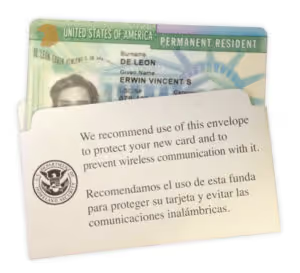
A visa allows you to stay in the U.S. for a set period of time, and when that time is up, you have to go. With a green card, however, you become a lawful permanent resident of the U.S., and you can live and work here indefinitely. Applying for a green card is the next step in the process of becoming a U.S. citizen.
Who can apply? People are granted green cards under similar categories that they are visas — i.e., based on having either family or employment in the U.S. Again, special categories exist, including status as a refugee or asylee (someone who has been granted asylum in the U.S.). It's important to note that except for immediate family of U.S. citizens, a limited number of green cards are issued each year, and there are priorities and preferences for certain categories of immigrants.
Getting a green card based on family: Priority is given to the spouse, parents and unmarried children under age 21 of a U.S. citizen. These people do not have to wait for a visa to become available before they can get a green card.
Read: The Ultimate Guide on Getting a Green Card
Getting a green card based on employment: There is also an order of preference for people who wish to immigrate to the U.S. for employment. First preference goes to "priority workers," including exceptional professors and researchers and others with extraordinary abilities. To see the complete order of preference for workers, visit the USCIS website.
Getting a green card based on humanitarian reasons: You may be able to get a green card through your status as a refugee or asylee.
- If you're a refugee, the law requires you to apply for your green card within a year of entering the U.S.
- If you have been granted asylum in the U.S., the law requires you to apply for your green card within a year of asylum status being granted
Other special categories: A variety of special categories exist that enable you to get a green card, including.
- You want to invest $1 million or more in a U.S. business
- You're a religious worker or member of the clergy coming here to work in certain circumstances
- You're a former overseas U.S. government worker
Once you file your green card application and all supporting documents and fees, USCIS will schedule an interview with you. For green card applications and help filling out the forms, visit SimpleCitizen.com.
The next step: Conditional permanent resident status vs. permanent resident status. Once you're approved (congrats!), you become a conditional permanent resident, and you'll be issued a conditional green card. It's good for two years. At some point during the 90 days before the card expires, you must file Form I-751, Petition to Remove Conditions on Residence. You cannot renew a two-year green card — you must apply to have the conditions removed.
Once the conditions are removed, you are granted a permanent resident green card. It's valid for 10 years. You may renew it by filing Form I-90, Application to Replace Permanent Resident Card.
So once you have your permanent resident green card, now you can apply to become a U.S. citizen, right?
Not quite.
Ways to Apply for a Green Card
Fill Out On a Computer
Download and view in a PDF viewer.
Download PDF
SimpleCitizen's Application Builder
Complete a Green Card application with SimpleCitizen.
Get Started*Includes Attorney Review
Print & Fill Out Paper Form
Print the PDF and fill by hand with black pen.
Print PDF
Hire a Legal Professional
Find a legal professional to complete the form.
Visit AILA.com
Step 3: Apply for American Citizenship (after 3 or 5 years)
You must be a permanent resident of the U.S. (aka having your green card) for five years before you become eligible for naturalization (aka becoming a U.S. citizen). USCIS does permit you to submit your naturalization application up to 90 days before your five-year anniversary.
Are there any exceptions to the five-year rule? Yes, there are:
- Permanent residents who are married to U.S. citizens only have to wait three years to apply for citizenship
- Battered spouses of a U.S. citizen also only have to wait three years
- Spouses of U.S. citizens in certain overseas jobs, refugees and asylees all have special circumstances that may permit them to apply for citizenship earlier than five years
Next step: You've had your green card for three or five years (or however long USCIS mandates, based on your status), and you'd like to apply for citizenship. Now it's time to file form N-400, the Application for Naturalization. A few important points about the N-400:
- The form can be completed with SimpleCitizen. Start here
- It costs $640 to file the N-400 plus an $85 biometrics fee (more on biometrics below)
- Read all the instructions carefully and always tell the truth
- It's a good idea to have an immigration lawyer review your form before you submit it
What happens next? Two things:
- Biometrics. You will be mailed a date for your biometrics services appointment. This is where USCIS captures your fingerprints, photograph and digital signature to confirm your identity and perform background and security checks.
- Citizenship interview. After biometrics are collected, you'll get an appointment for a citizenship interview with a USCIS officer. Make sure to bring the list of documents they request and be prepared to go over your application with the officer. You will be sworn in, and the officer will test your knowledge of English and U.S. history and government
Ways to Apply for Citizenship
Fill Out On a Computer
Download and view in a PDF viewer.
Download PDF
SimpleCitizen's Application Builder
Complete a Citizenship application with SimpleCitizen.
Get Started *Includes Attorney Review
Print & Fill Out Paper Form
Print the PDF and fill by hand with black pen.
Print PDF
Hire a Legal Professional
Find a legal professional to complete the form.
Visit AILA.com
You are almost a U.S. citizen! The final step is the oath ceremony, where you swear an oath of allegiance to the United States. In some courts, you will swear your oath on the same day as your citizenship interview, but if a same-day oath ceremony is not available, USCIS will notify you by mail of your ceremony date and time.
What happens in the oath ceremony? Before a judge, you will pledge to:
- Support and defend the U.S. Constitution
- Respect and obey all laws
- Pay income and other taxes honestly and on time
- Serve on a jury upon request
- Defend the country if needed
Once you swear your oath of allegiance, you will receive your certificate of naturalization. Congratulations! You are now a full-fledged U.S. citizen with all the rights that grants, including freedom of religion, the right to vote, right to a fair trial, and of course, life, liberty, and the pursuit of happiness.
Helpful Links:
Complete a Citizenship Application with SimpleCitizen
Citizenship Supporting Document Checklist
How long does it take to become a citizen?
Top 10 Green Card Application Mistakes
Top 10 Green Card Application Mistakes
Green Card Application
Last Updated: January 15, 2020.
Every year more than 1 million people apply to get a green card in the United States. This is an important moment in each one of these families lives, and for many, it is their first step towards citizenship in the United States. All of those green card applications mean a lot of paperwork for the US Citizenship and Immigration services (USCIS), and it also means a lot of mistakes. Mistakes can lead to delays, rejections, and in some cases, denials.
We have put together this list of some of the most common reasons green card applications are rejected. Reading this list can help you avoid some of the most common errors that people make when submitting their green card application.
1. Missing forms in your application
Potential Time Lost: 6 months to 2 years
A green card application is not one form that you fill out and submit to the US government. It is not that easy. A typical green card application is a complex web of about 6 to 8 different government forms and various supporting documents. All of these forms make up a complete green card application. Now you may be submitting an adjustment of status application for a relative already in the United States or you might be trying to apply for a green card for a spouse or parent that is in a different country. Either way, you are going to be submitting several forms to eventually get the green card.
Missing some of the required forms is an easy way to slow things down for your application. For example, in some cases you can submit all of the required forms to the US government at the same time. This is called a concurrent filing. This will cut down your process time by years. But make sure that you don’t miss any of the forms or you will lose valuable time.
2. Missing document translations
Potential Time Lost: 6 months
When you file a green card application you will be submitting many supporting documents to back up your information and prove that you really are who you say you are. The types of documents that you have to submit are birth certificates, marriage certificates, driver’s licenses, passports, visas, bank accounts, etc. If the documents are not already in english, a certified english translation will need to be included. Not getting your documents translated and getting the translation certified can delay your application by up to 6 months.
3. Forgetting to sign your forms
Potential Time Lost: 6 months
Potential Money Lost: $50-$100
All of the work spent on making sure you have a perfect application can be wasted if you don’t sign your forms AND sign them in the proper place. This is important: make sure that you SIGN ALL YOUR FORMS. Also, make sure that the correct person is signing the correct form. Some places the person getting the green card will be signing, the applicant or beneficiary. Sometimes the person who is sponsoring the person getting the green card will be signing, this person can be referred to as a petitioner or applicant on the actual USCIS forms. This part is tricky, but getting it wrong means an automatic rejection by the USCIS. Take a few minutes to double-check everything before shipping it off to the government.
4. Incorrect government payment
Potential Time Lost: 2-4 months
Potential Money Lost: $50-$100
Many people mess up the actual fees that the government charges to process the green card application. The USCIS is charging you a lot for your application and you need to make sure that you are signing your personal checks correctly and for the right amounts. The instructions on the USCIS forms will tell you how much it cost to process each form/application. If you are submitting an application for a green card, expect to be sending at least $1,000 to the US government. If you are only attaching a check for $100 or $300, then something is wrong. The USCIS will send your application back with an invoice for the correct amount. This will put you at the back of the line and leave you feeling frustrated.
5. Missing an important deadline
Potential Time Lost: 6 months
Potential Other Possible Repercussions: Denied Application
Once you enter the United States and begin your green card application process, the clock starts ticking with several important deadlines that you need to be aware of. You need to think about your visa expiration date, the dates for processing the application, the dates for the interview and finally the renewal deadline 2 years after. Missing these dates can be dangerous and result in a denied application. The US government takes these deadlines very seriously and will assume that you do not want to become a lawful permanent resident if you miss one. Make sure that you have a clear understanding of the timing of the application and where you will need to be when the time comes to avoid missing out on that appointment and becoming a green card holder.
6. Accidently giving false information
Potential Time Loss: 6 months – 1 year
Potential Other Possible Repercussions: LIFETIME BAN FROM US
Getting your background history wrong, even by accident, can be seen as lying on your application. If the US government thinks that you are lying on your application, your application is likely to get denied. Make sure that you have all of your dates, locations, criminal records, and important items handy while you are filling out the application. This way you can avoid mixing up your own history and creating serious complications for your application.
7. Falling for a scam
Potential Time Lost: 6 months – 2 years
Potential Money Lost: $500 - 5,000+
There are thousands of people trying to take advantage of immigrants every year. Notarios are just one type of scam out there. The most important thing to remember when going through the green card application process is “if it sounds too good to be true, it probably is”. Stay away from online websites that ask for a credit card without guarantees. Avoid shady lawyers that demand payments before hearing your case. Do your homework before trusting someone to help you with your immigration paperwork. If you make the mistake of getting scammed, you may lose your chances of becoming a legal permanent resident forever.
8. Not getting the right help
Potential Time Lost: 6 months
If you try to do something really complicated without any help, all by yourself, there is a good chance you will make a mistake. Immigration is not a game and mistakes are costly. Don’t waste valuable time and money trying to do everything by yourself. Immigration paperwork is scary even for people that speak English fluently. There are many organizations and resources to help you through this process. Use the resources and avoid mistakes. Every year, more than 100,000 applications are rejected by the USCIS due to avoidable mistakes. With the right help, you can easily avoid these mistakes and save yourself months and years of waiting. Not getting help can be one of the most costly mistakes.
9. Not being eligible to apply
Potential Time Lost: 6 months
If you submit a green card application and you don’t qualify, you will get rejected. This is a no-brainer, but sometimes figuring out when and how you can actually apply can be really tricky. If you make the mistake of submitting a green card application too soon, too late, with the wrong person, or for a thousand other reasons, you will lose months of valuable time. The USCIS has tools to help you figure this out. Even after doing your homework, sometimes it is helpful to consult with an immigration attorney to make sure you are not missing something important.
10. Financial requirement issues
Potential Time Lost: 2-4 months
When you submit a green card application you need to have a financial sponsor. This financial sponsor will be submitting the Form I-864, Affidavit of Support. There are several requirements for this person to be your financial sponsor; they need to be a US citizen, they need to live in the US, and they need to meet the income requirements as outlined in the Form I-864P, Poverty Guidelines for the Affidavit of Support.
If your sponsor doesn’t make enough money, they can have someone else step in as a joint-sponsor to include their income to meet the requirements. Adding another person like this also increases the amount of income needed. There could be a whole different 5 Common Mistakes Made on the Form I-864, and for this reason, it is a common trap for people trying to get a green card. Read the instructions carefully to make sure that if your petitioner doesn’t meet the requirements, that you are working with someone that does meet the requirements for their household size, plus the person that will be getting the green card.
This is not a complete list. There are many mistakes that people can make when submitting a green card application. These are just some of the most common. If you take your time and are very careful you will make it through this process without too much trouble. This is an exciting part of your life and you shouldn’t be worried and stressed about paperwork.
Canadian Birth Certificates & Green Cards: What You Need
Understanding Canadian birth certificates needed for green card applications.
U.S. Immigration News
Last updated: January 15, 2020
If you are from Canada and you are trying to get your green card you will need a specific copy of your birth certificate. You may be asking, "Which birth certificate will the USCIS accept for Canadian citizens?" or "Where to I get a copy of my Canadian birth certificate for a green card?" The following is a guide that will help you know which type of birth certificate is preferred by the USCIS and will be accepted with a green card, legal permanent residency application. Every year tens of thousands of Canadian-born immigrants go through the immigration process in the United States. At SimpleCitizen, we are proud of the fact that a large percentage of our customers hail from the Maple Leaf. Our friends from Canada enjoy special rules when obtaining visas, green cards and citizenship. Although some of the special rules make it easier for Canadian citizens to come to the United States they can cause some confusion as Canadians try to submit green card or citizenship applications. An essential and required piece of the green card application is a copy of the applicant’s birth certificate. This requirement is the source of a lot of confusion for Canadians trying to prepare an Adjustment of Status application for Legal Permanent Residency. Birth certificates in Canada are issued by the individual Province or Territory where the birth took place. There are basically two types of birth certificates that can be issued:
The Short Form or Small
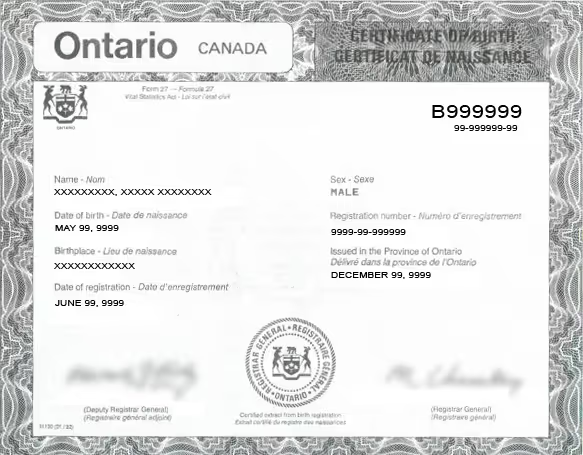
This certificate is printed on a small card. It is usually the size of a standard driver’s license and small enough to fit in a wallet (9.5 x 6.4 cm / 2.5 x 3.75 in). These certificates are not accepted by the USCIS or the DHS because they do not have required information such as the names of parents.
The Long Form, Large or Full-size
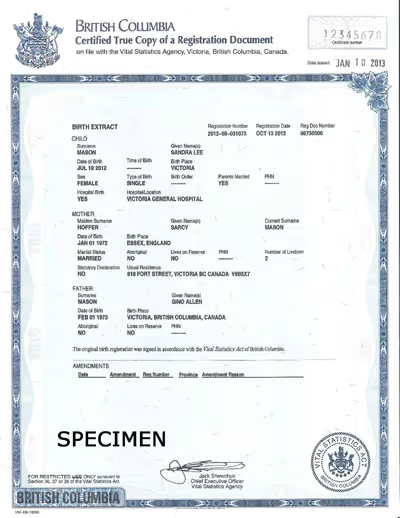
This certificate is a printed copy from the records of the province. It is usually on “currency-style paper stock” with intaglio border (21.6 x 17.8 cm / 7 x 8.25 in). These certificates are accepted by the USCIS and the DHS.There are specific types of birth certificates and each province has their own name for the certificate that is accepted by the USCIS and their own process for obtaining a copy. The following is a province-by-province guide for getting the right birth certificate attached to your green card application for the USCIS.
Alberta

If you were born in Alberta you need to attach a copy of your "large sized" certificate. If you don’t have a copy you can work with the Alberta Vital Statistics using a private Alberta Registry Agent. If you need information on official Registry Agents they are available online.
British Columbia

If you were born in British Columbia you need to attach a copy of your "large" certificate. If you don’t have a copy you can request one from the Vital Statistics Agency. They have offices in Victoria and Vancouver. You can also access copies through British Columbia Government Agents throughout the province. If you need information on official Government Agents, locations of Vital Statistics offices or mail-order instructions they are available online.
Manitoba

If you were born in Manitoba you need to include a copy of your "large" certificate. If you don’t have a copy you can obtain one from the Vital Statistics Agency. They have offices in Winnipeg (254 Portage Avenue, Winnipeg, 204-945-3701). If you need more information or mail-order instructions they are available online.
New Brunswick

If you were born in New Brunswick your immigration paperwork should include a copy of your "long-form certified copies" birth certificate. If you don’t have a copy you can obtain one from the Vital Statistics Office. Their office is located in Fredericton (435 King Street, Suite 203, tel: 506-453-2385). If you need more information or mail-order instructions they are available online.
Newfoundland and Labrador
If you were born in Newfoundland and Labrador you need to attach a copy of your "long-form certificates" birth certificate. If you don’t have a copy you can obtain one from the Vital Statistics Division. Their office is located in St. John’s (5 Mews Place, tel: 709-729-3308). You can also request a copy via one of the Government Service Center locations around the province. If you need more information, locations or mail-order instructions they are available online.
Northwest Territories

If you were born in Northwest Territories you need to make a copy of your "restricted photocopy" or “framing” birth certificate. If you don’t have a copy you can obtain one from the Registrar General of Vital Statistics. Their office is the Registrar General of Vital Statistics in the Inuvik Office of the Department of Health and Social Services ( tel: 867-777-7420). You can also request a copy via mail written to:Registrar General of Vital Statistics, Government of the NWT, Bag 9 (107 MacKenzie Road/IDC Building, second floor), Inuvik, NT, X0A 0T0 (fax: 867-777-3197).
Nova Scotia

If you were born in Nova Scotia your immigration paperwork should include a copy of your “large" birth certificate. If you don’t have a copy you can obtain one from the Vital Statistics Office. Their office is in Halifax (Joseph Howe Building, 1690 Hollis Street., ground floor, tel:902-424-4381). If you need more information or how to order via mail they are available online.
Nunavut

If you were born in Nunavut you need to attach a copy of your “large" birth certificate. If you don’t have a copy you can obtain a certified copy from the Vital Statistics Division. Their office is based out of the Kivalliq Regional Office of the Department of Health and Social Services (tel:867-645-2171). You can also request one via mail by writing to: Social Services, Bag 3 RSO Building, Rankin Inlet, NU, X0C 0G0 (fax: 867-645-2580).
- Note: Before April 1, 1999 Nunavut was part of the Northwest Territories. So if you were born in the Nunavut region of Northwest Territories before 1999, you should request your birth certificate from the Northwest Territories Registrar General of Vital Statistics.
Ontario

If you were born in Ontario you need to attach a copy of your "large" birth certificate. If you don’t have a copy you can obtain a certified one from the Office of the Registrar General. Their office is located in Toronto (Macdonald Block, 900 Bay Street, second floor, tel: 416-325-8305). You can also request a copy via one of the Ontario Land Registry Offices and Government Information Centers located throughout the province. If you need more information, locations or mail-order instructions they are available online.
Prince Edward Island

If you were born in Prince Edward Island and are completing your immigration paperwork you need to attach a copy of your "framing size" birth certificate. If you don’t have a copy you can obtain a certified copy from the Office of Vital Statistics. Their office is located in Montague (126 Douses Road, tel:902-838-0080). There is also an office in Charlottetown (16 Garfield Street, tel:902-368-6185). If you need more information, locations or mail-order instructions they are available online.
Quebec

If you were born in Quebec you should attach a copy of your "certified copies of an act" birth certificate. If you don’t have a copy you can obtain a certified copy from the Direction de l' Etat Civil. Their office is located in Montreal (2050, rue de Bleury, sixth floor, tel:514-864-3900). There is also an office in Quebec City (2535, boulevard Laurier, Ground Floor, Sainte-Foy, tel:418-643-3900; fax:418-646-3255). If you need more information, locations or mail-order instructions they are available online.
Saskatchewan

If you were born in Saskatchewan you should attach a certified copy of your "frame" birth certificate. If you don’t have a copy of this birth certificate you can request a copy of a registration from the Vital Statistics Office in Regina (1942 Hamilton Street, tel:306-787-3251).
Yukon Territory

If you were born in the Yukon Territory you should obtain a copy of your "large" birth certificate. If you don’t have one you can request certified copies of a registration from the Vital Statistics Agency in Whitehorse (204 Lambert Street, fourth floor, tel: 867-667-5207) or a Yukon Territorial Agent. Further information, including mail-order instructions, is available online.Hopefully this article has helped you understand exactly what Canadian documents you need to prepare and where you can find them when tackling immigration paperwork. Please share this article if you know someone from Canada that can use SimpleCitizen.
Getting a Green Card for Family Members
Getting a Green Card for Family Members
Green Card Application
Last Updated: May 8, 2024
Obtaining lawful permanent residence status, or a green card, is a necessary step on the way to becoming a U.S. Citizen. As a green card holder, in addition to the right to live and work in the U.S. on a permanent basis, you gain an important new set of rights. Significantly, you can now sponsor certain relatives applying for their own green cards. You are also allowed to travel from and return to the U.S. without disrupting your status. Green card holders can make campaign contributions, receive Social Security benefits after ten years of work in the country, and are eligible to get in-state tuition.. If you are interested in applying for a green card, this guide will help you understand the avenues for obtaining a green card, specifically detailing the process for those eligible through an immediate family member.
Green Card Eligibility
In general, to apply for permanent residence in the U.S. you must meet each of the following requirements.
- You must be eligible for one of the immigrant categories set forth by the Immigration and Nationality Act. The most common immigrant categories are having a qualified family member, having a job offer or employment, or being a refugee or having asylum status. There are many other avenues of eligibility, including for victims of trafficking and the Diversity Immigrant Visa Program, so consult the U.S. Citizenship and Immigration Services (USCIS) website to determine your status.
- For most immigrant categories, an immigrant petition that establishes the basis for your immigrant eligibility must be filed on your behalf.
- You must be eligible for admission to the United States, meaning there are no health-related, criminal, security or other grounds for inadmissibility.
- A visa must be immediately available. For immediate relatives of a U.S. Citizen, visas are always available, but for all others, there are a limited number of visas awarded each year. The order in which these visas are assigned is determined by immigrant visa preference categories under U.S. immigration law.
Immediate Relatives of U.S. Citizens Living in the U.S.
Parents, spouses, and unmarried children under the age of 21 (natural or adopted) of U.S. citizens are considered immediate relatives and do not have to wait to get a visa. If you are an immediate relative of a U.S. citizen and meet all of the green card eligibility requirements, you can file for a green card. If you are living inside of the United States, you may apply with Form I-485 (Application to Register Permanent Residence or Adjust Status) at the same time your sponsoring family member files Form I-130 (Petition for Alien Relative). This called concurrent filing (where you file all forms at the same time and to the same place) and is the preferred and most expedient way to file. However, if your sponsoring family member has previously filed Form I-130 and it has not been denied, you can still file your Form I-495 but must also attach a copy of Form I-797 (Notice of Action). Form I-797 is simply a receipt that shows your Form I-130 has been received or approved.
1. Filing Form I-130
This form is available on the USCIS website and must be completed by your sponsoring relative. In addition to completing the Form I-130, your sponsor must submit documents proving U.S. citizenship and documents proving the family relationship. Consult the USCIS website to determine what forms of proof are accepted. Any documents in a foreign language must be accompanied by a certified English translation.Click here to prepare your green card packet (including I-130) with SimpleCitizen.The filing fee for this form is $675. This fee cannot be waived. Consult the USCIS website for the correct address as it varies.
2. Filing Form I-485
You can find this form on the USCIS website. In addition to fully completing your Form I-485, you must provide the USCIS with supporting documentation. You must include evidence of your criminal history, if any, a copy of your foreign birth certificate or other birth records, a copy of the passport page from any nonimmigrant visa issued from a U.S. Embassy or consulate abroad within the past year, two passport-style color photos, and, if required, a medical examination report (Form I-693). Note that all documents in a foreign language must be accompanied by a certified English translation.The filing fee for Form I-485 is $1,440. If you are unable to pay this fee, a fee waiver might be available. Click here to prepare your green card packet (including I-485) with SimpleCitizen.
3. What Happens Next?
Within one to two weeks of submitting your paperwork, you will receive Form I-797 (Notice of Action), which includes a receipt number from the USCIS that will allow you to track the status of your application. To check your status, go to USCIS.gov, enter the thirteen digit receipt number, and click "Check Status." Next, sometime after your application is filed, you will be notified in writing where and when you must go for a biometric services appointment, which entails fingerprinting and possibly taking a photo or submitting your signature. If you do not go to this appointment, your application might be denied. Finally, you will be called in for an interview at your local USCIS office. It is possible your green card will be approved at this interview.Although the wait time for an interview can vary, for an immigrant spouse living in the U.S. after legal entry, the average wait is six months to a year. Within 30 days of being informed that your green card has been approved, you will receive a welcome notice from the USCIS. Then within 30 days of receiving the welcome notice, you will finally get your green card in the mail.
Non-Immediate Family Members
Parents, spouses, and unmarried children under the age of 21 (natural or adopted) of U.S. citizens are considered immediate relatives and do not have to wait to get a visa. However, other qualified relatives are placed in preference categories depending on their relationship to the sponsor. U.S. Immigration law limits both the number of visas given to each category every year and the total given to each country. There are 226,000 family-sponsored preference visas allocated each year, and each category is given a law-mandated percentage of that total. The wait to submit a visa application can be years or even decades.To start the visa process, the sponsoring family member must file a visa petition (document form I-130). The date this petition is properly filed becomes the applicant’s “Priority Date.” Each month, the State Department puts out the Visa Bulletin, listing which Priority Dates can submit their visa application for each preference category. The Visa Bulletin actually lists two dates- those priority dates that are Eligible for Final Action, which means their visas are ready to be issued, and priority dates that are Eligible for Filing, which is the date those people can file their application for a visa, often years before their visa is ready to be issued. The visa application is called an “Adjustment of Status” application. Many choose to file ahead of time because those with pending applications are eligible for temporary Employment Authorization Documents and Travel Permission while they wait for their visa.There are four family-sponsored preference categories. The priority dates eligible for final action and filing are determined by these preference categories, as well as the current country of citizenship (called the country of chargeability). There are some countries (mainland-born China, India, Mexico and the Philippines) that have a high number of applicants and therefore applicants from those countries may have longer wait times than others in their same preference category.
The First Family Preference (F1)
F1 is for unmarried sons and daughters of U.S. Citizens over the age of 21, and their children, if any. As of May 2017, the wait for applicants in this preference category, not from a high volume country, was almost seven years from their priority date. The waits for high volume countries vary. For example, the wait for Mexican applicants to be eligible for a visa is currently twelve years, whereas those from China and India are waiting seven years.
The Second Family Preference (F2)
F2 is divided into two sub-preference categories (F2A and F2B). F2A covers spouses and children (under 21) of permanent residents. As of May 2017, the wait for applicants in this preference category, not from a high volume country, was about two years from their priority date. F2B is for unmarried sons and daughters (over 21) of permanent residents. As of May 2017, the wait for applicants in this preference category, not from a high volume country, was almost seven years from their priority date.
The Third Family Preference (F3)
F3 covers married sons and daughters of U.S. citizens, their spouses and minor children. As of May 2017, the wait for applicants in this preference category, not from a high volume country, was about twelve years from their priority date.
The Fourth Family Preference (F4)
F4 covers brothers and sisters of adult U.S. citizens, their spouses and minor children. As of May 2017, the wait for applicants in this preference category, not from a high volume country, was around thirteen years from their priority date.
Helpful links
SimpleCitizen's 2017 Green Card Application Guide
Find out if you are eligible to apply
Marriage Based Green Card Interview Questions
Where do you Send Form I-130?
This article outlines where to submit Form I-130.
USCIS Forms
Last Updated: June 6, 2025.
Once you have filled out Form I-130 and gathered all supporting documentation, you’re ready to send it in to USCIS! But where you send the form is different depending on where you live and whether or not you are filing Form I-130 with any other forms.
Please be aware that USCIS updates this information frequently, so be sure to check the USCIS Form I-130 Direct Filing Address page for the most up-to-date mailing information. If you are filing Form I-130 concurrently (at the same time) as Form I-485, please defer to the USCIS Form I-485 Direct Filing Address page instead.
USCIS Phoenix Lockbox Facility
If you live in any of the following states or territories, and are ONLY filing Form I-130, you will send your Form to the USCIS Phoenix Lockbox facility.
- Alaska
- American Samoa
- Arizona
- California
- Colorado
- The Commonwealth of the Northern Mariana Islands
- Florida
- Guam
- Hawaii
- Idaho
- Kansas
- Montana
- Nebraska
- Nevada
- New Mexico
- North Dakota
- Oklahoma
- Oregon
- Puerto Rico
- South Dakota
- Texas
- Utah
- Virgin Islands
- Washington
- Wyoming
If you are sending the form through the U.S. Postal Service (USPS), please address the envelope:
USCIS
Attn: I-130
P.O. Box 21700
Phoenix, AZ 85036-1700
If you are sending the form through Express mail or through a commercial courier, please address the envelope:
USCIS
Attn: I-130 (Box 21700)
2108 E. Elliot Rd.
Tempe, AZ 85284-1806
USCIS Elgin Lockbox Facility
If you are only filing Form I-130 and live in any of the following states or territories, you will send the form to the USCIS Elgin Lockbox facility:
- Alabama
- Arkansas
- Armed Forces Americas
- Armed Forces Europe
- Armed Forces Pacific
- Connecticut
- Delaware
- Georgia
- Illinois
- Indiana
- Iowa
- Kentucky
- Louisiana
- Maine
- Marshall Islands
- Maryland
- Massachusetts
- Michigan
- Micronesia
- Minnesota
- Mississippi
- Missouri
- New Hampshire
- New Jersey
- New York
- North Carolina
- Ohio
- Palau
- Pennsylvania
- Rhode Island
- South Carolina
- Tennessee
- Vermont
- Virginia
- Washington, D.C.
- West Virginia
- Wisconsin
If you are sending the form through the U.S. Postal Service (USPS), please address the envelope:
USCIS
Attn: I-130
P.O. Box 4053
Carol Stream, IL 60197-4053
If you are sending the form through Express mail or through a commercial courier, please address the envelope:
USCIS
Attn: I-130 (Box 4053)
2500 Westfield Drive
Elgin, IL 60124-7836
USCIS Elgin Lockbox Facility (International)
You are only filing Form I-130, and you live outside the United States*
If you are sending the form through the U.S. Postal Service (USPS), please address the envelope:
USCIS
Attn: I-130
P.O. Box 4053
Carol Stream, IL 60197-4053
If you are sending the form through Express mail or through a commercial courier, please address the envelope:
USCIS
Attn: I-130 (Box 4053)
2500 Westfield Drive
Elgin, IL 60124-7836
*You may request to file at the U.S. Embassy or Consulate in certain limited circumstances. See the USCIS filing page for more info.
Understanding who you can petition for a green card using Form I-130.
Understanding who you can petition for a green card using Form I-130.
USCIS Forms
There is a difference between citizens and lawful permanent residents (meaning residents with green cards) when it comes to whom you may file Form I-130 for. If you are a United States citizen you may file Form I-130 for numerous relatives, including:
- Your spouse
- Your unmarried child under age 21
- Your unmarried son or daughter age 21 or older
- Your married son or daughter of any age
- Your brother(s) or sister(s) if you are 21 or older; and
- Your mother or father if you are 21 or older.
However, if you’re a lawful permanent resident you may only file the Form for:
- Your spouse
- Your unmarried child under age 21; and
- Your unmarried son or daughter age 21 or older.
If you want to file for more than one relative, you must complete a separate Form for each individual. There is no limit to the number of Forms you can submit as long as each relative fits into the categories listed under “citizen” or “lawful permanent resident” above.[eligibility-quiz-green-card]
How Much Does it Cost to Submit Form I-130?
Read to learn more about how much it costs to file Form I-130, Petition for Alien Relative.
USCIS Forms
Last Updated: May 8, 2024.
Filing Form I-130 costs $675 and it can be paid with a check or money order. No matter how you pay, the following two guidelines must be followed:
- The payment must come from a bank or financial institution in the United States and be payable in U.S. dollars.
- The payment must be made payable to: U.S. Department of Homeland Security. This must be spelled out and cannot be abbreviated.
Memo:
If you are paying by check, write the full name of the applicant in the memo line followed by the title of the form associated with the payment. For example, "Tom Smith, I-485".If you choose to pay by check, the U.S. Department of Homeland Security will use your account information on the check to electronically take the money from your account. Typically, the debit will take 24 hours and will show up on your regular account statement.Please note that you will not receive your original check back. Instead, it will be destroyed and the government will keep a copy of the check on file.