
Green Card Renewals, Replacements and Removal of Conditions
Learn more about Removing Conditions from a 2-year green card.
Calculating When to File for the Removal of Conditions
Understanding the filing window for your 2-year, conditional green card.
USCIS requires people to file to remove the conditions on their 2-year, conditional green card. If filing jointly with your spouse or parent’s spouse this must only be filed within the 90 days before it cards expiry date. Filing the removal of conditions application before the 90-day window results in the rejection of the application and filing after the 90-day window could result in the denial of the application. This 90 day rule does not apply for certain situations such as those shown on the following chart from USCIS:
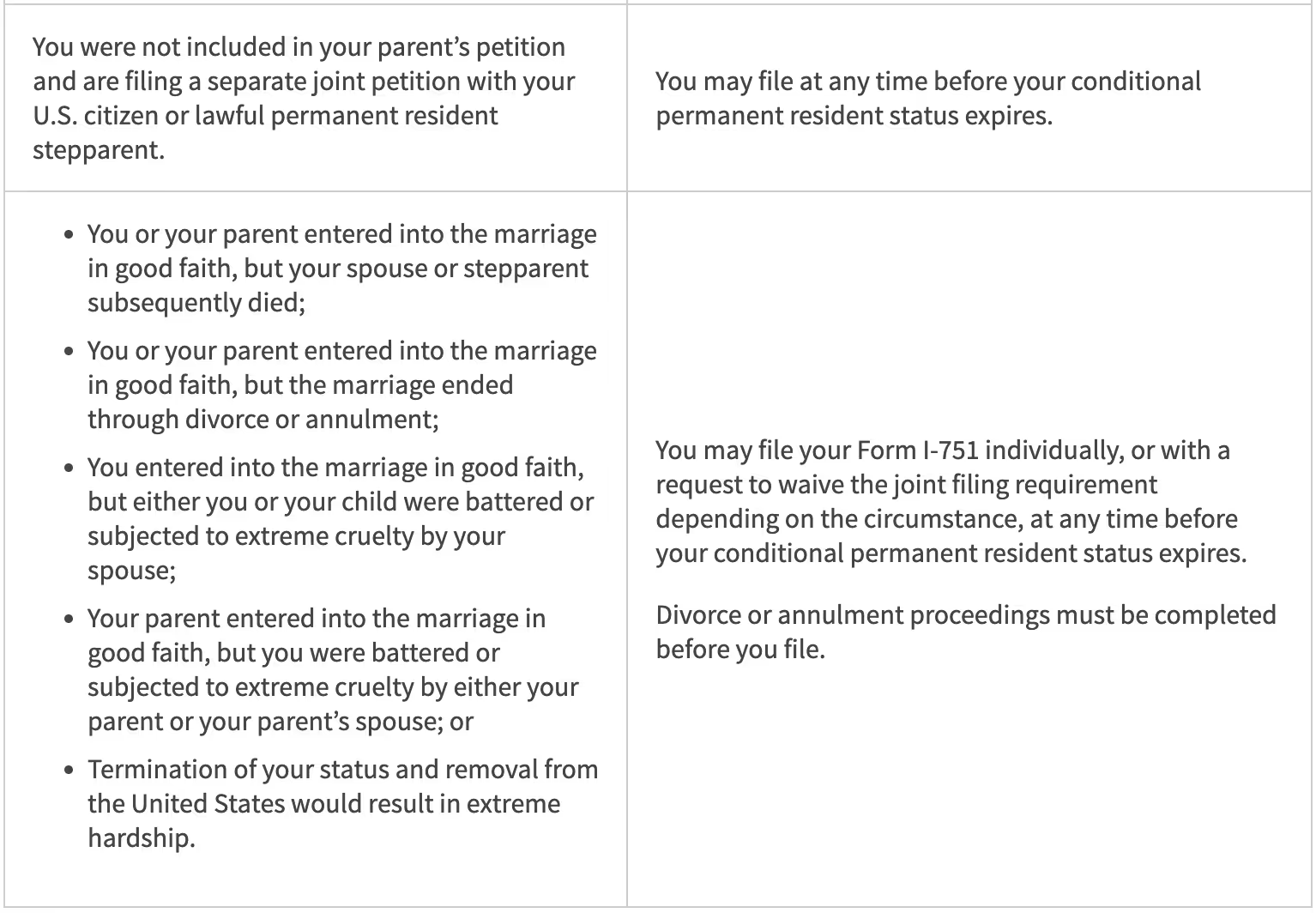
Please note that USCIS calculates the submission date based on the day the application arrives at their office. Applicants should take care that they do not accidentally have their application delivered even one day early. Applicants have been rejected because the mailing service they used got their application to USCIS one day before their 90-day window began.
When necessary, an applicant can file after the 90 day period by providing a good explanation along with the application detailing the circumstances that caused them to file late. However, please note that this does not guarantee that USCIS will accept the late filing, though it can help increase the odds.
You can calculate your approved filing window using the USCIS filing date calculator here. In order to use this calculator, you will need to know the expiry date of your Conditional Permanent Residence, which should be listed on your 2-year green card.
Additionally, please feel free to use the following examples to help you better understand how to determine the approved filing window for your Removal of Conditions application.
Example: If Sarah’s 2-year conditional green card expires on July 4th, 2023 (07/04/2023) the soonest she would be able to file her I-751 application with USCIS sometime between April 5th 2023 (04/05/2023) and July 4th, 2023.
Form I-751 & How to Prove Your Marriage is Legitimate
This article outlines strategies to help make your Removal of Conditions application stronger.
Last Updated: April 8, 2024
After applying for a green card through marriage to a U.S. citizen or lawful permanent resident (LPR), a person is given a “conditional residence” status if their marriage was less than two years old on the day that they were lawfully admitted to the United States or were granted their green card. This conditional residence status grants the individual a green card that is valid for two years instead of the typical ten given to permanent residents. This means that their green card is conditional on their marriage to their US-connection (spouse) and they must come back and prove to USCIS that their marriage was/is legitimate.
After two years, applicants are able to file to have the conditions removed from their green card and request that they be granted permanent resident status without conditions so that they can be granted a 10-year green card. This is often referred to as the Removal of Conditions application and is done by filing Form I-751, Petition to Remove the Conditions of Residence.
One of the primary purposes of this application is to provide USCIS with extensive proof that the marriage has continued and is legitimate. If a marriage has ended before applying for a Removal of Conditions, extensive proof of the relationship being legitimate will be needed and the application will be subject to a higher degree of scrutiny from USCIS. This article outlines different strategies that can be implemented in order to help a Removal of Conditions application have the highest chance of success possible.
Below, we have detailed the following for you:
- Form I–751 Overview
- Warning Signs USCIS looks for when Adjudicating Form I-751 applications
- Evidence Recommendations to Strengthen an Application
- Tips for uploading relationship evidence to your SimpleCitizen Account
Form I-751 Overview
Here is a brief overview of some of the key points to remember when filing Form I-751 and applying to remove the conditions from a conditional green card:
- A person must pass a period of conditional residence if their status is based on a marriage that is less than 2 years old.
- The period of conditional residence is 2 years.
- A person must file the I-751 within the 90 days before their conditional green card expires. Failing to do so could result in the loss of permanent status and their removal from the United States. If you want help calculating the date you are eligible to file for your Removal of conditions, click here.
- The form must be filed jointly by the two spouses in most situations. However, there are some exceptions in instances of divorce or the death of the spouse. For more information on filing Form I-751 with a divorce waiver, please view the following article: here
- The filing fee for an I-751 is $750.
- If a dependent child is added an extra biometrics fee is also added for each dependent child on the form.
If you’re looking for a complete guide on how to complete and submit the Form I-751, click here.
What is the difference between Removing the Conditions of my Green Card and only Renewing my Green Card?
People who have been granted an initial 2 year green card go through the process of applying for Removal of Conditions and use Form I-751. People with an already 10 year green card about to expire need to Renew their Green Card and must file Form I-90. When applying to remove the conditions, a 2-year green card holder needs to submit with their application various evidence and information to show USCIS the ongoing relationship to the sponsor that petitioned for their green card in the first place. You can find more information about the two forms and their differences here.
Showing Evidence & Proving your Legitimate Marriage
The “burden of proof” is the responsibility of a person to present evidence that their marriage has been entered in good faith , and therefore removal of conditions of their green card should be granted. Essentially, USCIS requires that new evidence be submitted to show The “burden of proof” is placed on the person applying for removal of conditions.
In this portion of the article we will provide important information about some situations that can present red-flags for USCIS adjudicators and we will give applicants examples of important evidence people can add to their application to satisfy the “burden of proof” required by USCIS.
Warning Signs:
USCIS adjudicators assign different fraud warning levels to applications based on their relationship evidence and the circumstances of their case.
Here is a list of example scenarios that could potentially raise red-flags for fraud from USCIS on a person’s application:
- Large disparity of age
- Inability of petitioner and beneficiary to speak each other’s language.
- Vast difference in cultural and ethnic background
- Family or friends unaware of the marriage
- Marriage arranged by a third party
- Marriage contracted immediately following the beneficiary’s apprehension or receipt of notification to depart the United States
- Discrepancies in statements on questions for which a husband and wife should have common knowledge
- No cohabitation since marriage, even if there are valid reasons
- Beneficiary is a friend of the family
- The petitioner has filed previous petitions on behalf of aliens, especially alien spouses
- Limited relationship evidence
In cases where the fraud level increases, the likelihood of an interview also increases. For applicants experiencing any of the situations listed above, it can be extremely helpful to include extensive relationship evidence that supports the validity of the relationship.
Proving Your Legitimate Marriage
Although a marriage certificate is required and proves a marriage is legally established, it does not prove the marriage was entered in good faith. To prove the legitimacy of the relationship, it is best practice to provide as many documents as possible to show the nature of the marriage and equally as important is that this evidence extends throughout the full duration of the relationship.
We have seen customers find the most success when their evidence is extensive and varied. If a benchmark would be helpful for you, it could be useful to aim for approximately 100-200 pieces of evidence with approximately 10-15 different evidence types. The evidence should span the full duration of the relationship.
Examples of evidence we have seen be preferred by USCIS for customers in the past includes the following:
- Evidence of spending time together
- Evidence of joint financial responsibilities
- Evidence of living together
- Evidence of raising children together
We have included lists for each of these evidence categories below with extensive examples of acceptable evidence.
IMPORTANT TIPS BEFORE STARTING:
- When adding evidence it is important to make sure the documents added clearly show that the evidence belongs to the couple, either by having BOTH people in the pictures or clearly showing BOTH names under the documents the couple is adding.
- It is important they show varied evidence not only from the current year but from all the years that the couple has been married. When adding pictures, joint leases, joint bank accounts, joint utility bills, joint insurances, tax returns, joint utility bills, etc.
- If possible, add 3-4 copies of these documents for EVERY YEAR the couple has been together.
1. Evidence of spending time together

Most married couples do things together. Showing evidence of the relationship, and of the couple doing things together is a key way of showing a good faith marriage. Here are some examples of documents that can help prove a couple’s time spent together and therefore a marriage entered in good faith:
- Photos from joint vacations or trips, especially trips abroad to visit relatives at different times during the full duration of the marriage. Listing names and dates of the photographs is usually helpful.
- Photographs from the couple’s wedding, honeymoon, get-aways, family meals, holidays, etc. List the date and names of the people in the photographs.
- Travel itineraries and lodging bookings from joint vacations or get-aways showing both names.
- Cards from loved ones complimenting you on your wedding, anniversary, or other joint life events.
- Evidence that the spouses have met or communicated with each other's parents and relatives, including photographs, letters, cards, emails, messages, etc.
- Telephone and instant message records that show both names demonstrate that the spouses communicate regularly.
- Tickets to events both spouses attend or plan to attend.
- Receipts for gifts spouses bought for each other.
- Records of social media posts and interactions, including screenshots of Facebook pages, Twitter posts, Instagram posts, etc. that include timestamps.
- Documents showing membership in the same clubs, churches, teams, etc.
- Documents showing that one spouse took the other’s last name.
2. Evidence of joint financial responsibilities

Many married couples combine finances in a shared effort. Even if a couple would otherwise prefer to keep finances separate, it might not be a bad idea to commingle finances to help show evidence of a good faith marriage. A person can use these documents to show evidence of joint financial responsibilities. -
- Bank statements for joint accounts with both names from throughout the whole time the account has been shared. Usually 1 bank statement for every 3-4 months can be good evidence.
- Statements for loans where one spouse is a co-signer for the other spouse.
- Voided and canceled checks for joint accounts.
- Joint insurance agreements, statements, and cards, including health, life, property, and auto insurance, etc.
- Utility bills showing both names, including, cell phone, trash, cable, internet, electricity, water, gas bills, etc throughout the whole time the bills have been shared. Usually one statement for every 3-4 months per bill type can be good evidence.
- Joint memberships and subscriptions such as Amazon, Costco, Netflix, gym memberships, etc. You can add screenshots or cards that show both people under the same membership.
- Life insurance policies, wills, and trusts, showing a spouse as a beneficiary.
- Documents showing joint ownership of cars, real property, or investments.
- All Tax returns filed jointly as a married couple showing both names (with the couple’s W-2s).
- Funeral plans or intended burial locations that involve or are close to a spouse.
- Copies of bank statements from separate accounts and payment receipts showing that the spouses both contribute to financial responsibilities and payments. For example, bank statements from separate accounts could show that each spouse pays half of rent each month.
- Copies of driver’s licenses showing the same address for each spouse;
- Copies of vehicle titles showing joint ownership.
- Money transfers.
Commingling finances isn’t required, however, it provides good evidence of a good faith marriage and failing to include it can make a case more vulnerable to scrutiny.
3. Evidence of living together

Because most married couples live together USCIS sees this as another strong form of relationship evidence. Showing evidence of cohabitation, or living together is a good place to start. Remember, USCIS wants to see evidence for the full duration of the relationship so evidence should be provided for the full length of time the couple has lived together. Use these documents to show evidence of cohabitation:
Primary Evidence:
- Mortgage or loan papers with both names extending back the full duration of the relationship.
- Lease agreement showing both names extending back the full duration of the relationship.
- Deed to property indicating both names.
Secondary Evidence:
- Bank statements giving the same address for both spouses.
- Driver’s licenses or identification documents showing the same address.
- Voided or canceled checks showing the same address.
- Property insurance agreements, statements, or cards showing the same address.
- Health and life insurance statements showing the same address.
- Correspondence from friends, family, or businesses showing the same address.
- Utility bills showing the same address, including, cell phone, trash, cable, internet, electricity, water, gas bills, etc.Usually one statement for every 3-4 months per bill type can be good evidence.
- Affidavits from family, friends, neighbors, and landlords testifying of cohabitation (more on this later).
Cohabitation isn’t required for a marriage to be legitimate, however if a couple has not lived together for their duration of their marriage or for long periods of time this can make a case more vulnerable to scrutiny. Some circumstances require spouses to live separately, such as jobs in different locations and military service. While this circumstance could cause higher scrutiny by USCIS individuals in this situation can add letters explaining the reasoning for living apart and any future plans of moving in together.
4. Evidence of raising children together

Showing proof of raising children together will provide evidence of a legitimate marriage. Use these documents to show evidence of raising children together:
- Adoption certificates showing the two spouses as the parents.
- Birth certificates showing both spouses as parents.
- Documents that show a relationship with children or step-children, including vacation itineraries, photos, school records, affidavits from friends, family, and teachers.
- Documents showing the step-parent as the emergency contact for a step-child, including, doctor’s records, school records, etc.
- Medical records showing an ongoing pregnancy.
Again, it isn’t required to have or raise children together. It is just helpful evidence to show a good faith marriage. Evidence of raising step- or adopted children together can also be good evidence to add into an application.
Affidavits
Affidavits were listed above as documents that could provide evidence of intimacy, cohabitation, and raising children together. “Affidavit” is just a formal word for a written statement for legal use that is confirmed by oath. Affidavits can be very convincing. Spouses can get their family, friends, neighbors, and employers to write down their personal observations witnessing the legitimacy of the marriage.
You can find more information about the affidavits of support from families and friends here.
Tips for uploading relationship evidence to the SimpleCitizen platform:
Uploading organized relationship evidence is important so that the USCIS officer can easily look through your application. The easiest way to upload relationship evidence is to organize it by evidence type, merge the documents into PDFs, and then upload them under the different categories.
For example, for bank statements, putting them in chronological order, putting them all into a single PDF, and then uploading a single Bank Statements document is often the simplest way.
For photos, people often put them into a word document or powerpoint presentation and then save the file as a single PDF and then upload that.
You can use a program like the following website to merge your documents. Please be sure to find one that you trust. Adobe Acrobat, if you have it, tends to be a secure and user-friendly option.
5 Tips for Removing Conditions After a Divorce
Tips for filing for a Removal of Conditions after a divorce.
Last Updated: January 15, 2020.
Removing conditions can be a relatively straightforward process, especially if you and your spouse provide enough bonafide evidence to convince the United States Citizenship and Immigration Services (USCIS) that your marriage is legitimate.
However, if you were divorced during the conditional period, the process can become more complicated.
What is the Form I-751 Petition to Remove Conditions on Residence?
When a U.S. citizen and a foreign national get married, the USCIS grants a conditional 2-year green card. The 2-year conditional period is designed to allow the USCIS to make sure the marriage is legitimate. The conditional green card process can be avoided if the couple files for the green card 2 year or more after their date of marriage.
After two years, you will need to petition to the USCIS to prove that your marriage is legitimate and entered in “good faith”. Form I-751, Petition to Remove Conditions on Residence is the form you will file to remove your conditions and apply for a 10-year green card.
You can submit the form 90 days prior to your green card expiration date. If you fail to remove conditions before the expiration date, you will lose your lawful permanent residence status, and the process for removal will commence. If your 2-year green card has expired and you haven’t filed to remove your conditions, you should call an immigration attorney immediately. Here you can find a list of high-quality attorneys in your area.
You are generally eligible to remove your conditions if:
- You are still married to the same U.S. citizen.
- You entered into your current or previous marriage “in good faith” but you or your child were battered or abused by the U.S. Citizen that you married.
- You entered into your marriage “in good faith” but the marriage ended through divorce or annulment.
- You entered into your previous marriage “in good faith” but you were widow.
1. Don't Forget the Waiver
The portion of Form I-751 that is applicable to marriage status is under Part 3: Basis for Petition and is known as “Joint Filing”. This section of the form requires that you identify whether or not your spouse will be participating with you in filing this petition for condition removal. Further down, in section 7, signatures are required from both parties.
In part 3, underneath the section on Joint Filing, there is a section to request a waiver to avoid Joint Filing. The only reason that Joint Filing may need to be waived is if the relationship in your marriage is damaged or presence of your spouse deems Joint Filling impossible.
Conditions that may require the waiver:
- Your spouse is deceased.
- The marriage was terminated.
- You were subject to cruelty in your marriage.
- Removal from the United States back to your home country would create significant hardship.
If these conditions apply to you, check the appropriate box in the section under part 3. Be aware that if you check the box indicating that you and your spouse were divorced before your two year anniversary, you will receive an RFE (request for evidence) which must include you final divorce decree.
2. If Your Divorce is Not Finalized
So what happens if you don’t have a final divorce decree? This may be the case if you and your spouse have separated, but have not started or completed the divorce process prior to the 90-day deadline. Additionally, this may be the case if you are still married but your spouse refuses to file the I-751 form with you.
There are three courses of action that you may take in this situation:
- You may choose to remain married through the separation, and file for the waiver under battery. This option is only available to you if these conditions apply to your individual situation.
- You may send in evidence that the divorce process has begun. This process may be a risky one if the divorce is not finalized in time to respond to the RFE (which requires a finalized divorce decree). There may be unfortunate consequences if this is the case.
- If you had applied prior to your 2-year anniversary, failure to respond to the RFE will result in the commencement of removal proceedings.
- If you had already begun removal proceedings due to expiration of your conditional card,failure to produce a final decree may result in the judge not giving you a second chance. You may be removed from the United States. Wait until your conditional green card has expired, and then appeal once the removal proceedings have begun.
If you are caught in any of these situations, you should contact an immigration attorney.
3. Gather The Evidence
As you may have noticed from the previous qualifications mentioned in this article, one possibly confusing phrase that is used, is “in good faith”. This phrase refers to the original intent behind your marriage. Now, you may be asking how the government could reasonably measure something as subjective as intent.
There is an order of information you may be required to produce to prove that your marriage was of “good faith”. This is especially true if your marriage has ended, because it calls the original intent of your marriage into question. To make sure that you and your spouse were not taking advantage of the system, anything that proves the genuine nature of your marriage will be accepted.
The criteria for information that can be provided all show proof that you and your partner attempted to build a life of substance together. This shows commitment and good intention. The following will contribute to your case that your marriage was “in good faith” (in order from most to least helpful):
- You and your spouse not only have children, but have children together:
- Provide birth certificates to prove that the two of you had biological children together
- Provide adoption records to prove that you adopted a child together if biological children were not possible or preferred
- You share resources:
- Things you can provide to prove the existence of a shared financial or other resource system:
- Proof of shared bank accounts or funds
- Proof of shared maintenance on a home
- Proof of tax returns
- Credit card or loan statements
- Leases, mortgages, or deeds
- Common club membership
- Common religious organization
- Common associations
- Common teams
- Anything that has your shared names on it
- Things you can provide to prove the existence of a shared financial or other resource system:
If you are currently living apart, because of the importance of this type of proof in showing you have built a life together, you will provide a detailed explanation for why you are living apart.
- You have shared insurance and estate:
- Provide proof of shared home insurance
- Provide proof of shared auto insurance
- Provide wills or trusts
- Provide proof of funeral plans
- This may include set-aside finances or planned locations for burial
- You have shared vacations:
- Provide travel documents (plane tickets, event tickets, etc.)
- Provide itineraries for past vacations
If you can provide proof that your spouse went to visit your family outside of the United States, that is a great indicator of a marriage “in good faith”.
- You have photographs or gifts:
- Provide wedding or other event pictures
- Provide receipts for gifts
- Provide cards that accompanied any gifts
- You have a shared name:
- Provide proof of shared surname
- You have affidavits, letters, and correspondence:
- Provide letters
- Provide Facebook messages
- Etc.
Gather whatever you think you may need well in advance.
Do not procrastinate this step until the end so that you may ensure that you can provide the best information to give you the best chance at getting your waiver approved.
Extra tip:
Once again, any evidence that you think would show the original success and intention of the marriage should be included. Provide anything that you have access to because it is better to have too much evidence that you had a good marriage rather than risk not providing enough. Specifically, be sure to provide as many types of evidence as possible rather than just large amounts of one type of evidence.
Example: Providing 1,000 pictures of the two of you is not nearly as effective as providing a few event photos along with statements of financial cooperation and travel documents.
Be sure that if you provide a lot of information, you are aiming for a wide range of quality inclusions rather than just large quantity of one inclusion.
4. Paying Attention to Timeline
With something as time-sensitive as a conditional green card, deadlines can make or break you.
If 2-year green card is 90 days from expiring, you can file Form I-751. If you have submitted the I-751 on time but are expecting an RFE, be prepared to provide the necessary information in a timely manner.
5. Divorce by Extreme Hardship
As part of request for evidence, you will likely want to include a written explanation of why your relationship ended. This will allow the government to see exactly who is at fault and it may help your case significantly.
In this process you may claim no fault divorce or that the divorce was your spouse’s fault.
In no fault divorce, you may want to explain exactly what split the two of your apart. It could be a mutual disagreement on finances, the choice to have children, etc. In this case, be prepared to prove that the marriage was “in good faith”.
If the fault all belongs to your spouse, you will want to provide any evidence that was used in your divorce case to prove this. This situation could apply if you were abandoned or anything else done to split the marriage. Once again, any information you could possible provide as long as it is true and quality will only help you case.
This second option (spouse’s fault divorce) can also qualify you to petition for a waiver under extreme hardship. This is one of the options on the I-751 under the waiver section.
You may also check the box if any of these apply to you:
- You have lived in the United States for so long that you have lost all ties to your home country.
- You can’t get a divorce due to religious or cultural tradition.
- You would experience persecution or alienation in your country.
- You have a medical condition that can’t be treated properly in the conditions of your home country.
- You would have difficulty finding a job in your home country.
- Your United States relatives would experience great financial loss without your income.
- You do not speak the language of your home country.
- You are the primary caregiver of children born in the United States (citizens) and they would have to come with you to your home country.
Again, be prepared to provide appropriate and thorough evidence if you claim any of these situations.
Recap:
- Know the I-751 process.
- Make informed decisions so you fill out the petition to fit your individual needs.
- Gather all of your evidence well in advance so you can thoroughly support your claims.
- Pay attention to deadlines so you stay on top of the approval process.
- Know your situation so you know if extreme hardship can apply to you.
For more help with filing the I-751 and other immigration questions, visit www.simplecitizen.com and chat with one of our immigration experts!
Top 5 Reasons Green Card Renewal Applications are Rejected
Read more to learn about the Top 5 Reasons Green Card Renewal Applications are Rejected.
Top 5 Reasons Green Card Renewal Applications are Denied
Before you know it, 10 years have flown by and it’s time to submit your Green Card renewal application.
According to the U.S. Citizenship and Immigration Services (USCIS), green card holders can renew their 10-year Green Card within 6 months of its expiration date.

As you probably know, getting a Green Card is not easy.
Link: The Comprehensive Guide on How to Get a Green Card
Fortunately, the Green Card renewal process is often much simpler than the initial Green Card application. We know this because hundreds of immigrants have used SimpleCitizen to create and submit their own Green Card renewal applications. Preparing your application with the support of immigration professionals can help you avoid expensive and/or time-consuming mistakes, and can even help you avoid an application denial.
While a Green Card Renewal denial is fairly rare, it does happen. If you choose to prepare your application on your own, please consider avoiding these 5 most common mistakes that can lead to a potential rejection or denial:
5. You were “Ordered Removed”
If you were ordered removed from the United States, your green card renewal is more likely to be denied. You are ordered removed if at least one of the following has happened to you:
- A judge ordered you deported or removed
- You signed a stipulated removal order
- You were at the border, and immigration officials completed Expedited Removal paperwork on you
(Note: This is not simply being refused entry)
Also note that you are not considered “ordered removed” simply if your visa category is Z11, Z13, Z14, or Z15. These categories are based on a “suspension of deportation” or “suspension of removal” which is different from being ordered removed.
4. You’ve committed a crime
If you have committed a felony or misdemeanor, the best course of action is to seek advice from a licensed immigration attorney before filing to renew your green card. If you speak with an immigration attorney, you are much more likely to successfully obtain a renewed green card.
3. You submitted an incomplete application
Be careful to read all the instructions. These 4 parts of the green card renewal application are often missed:
- Remember to sign in all the right places.
- Be sure to attach all required evidence (requested photocopies of official documents).
- Make sure to pay the I-90 filing fee.
- Be sure to attend your scheduled biometrics appointment.
As long as you read and follow the instructions carefully, you shouldn’t have to worry.
A few weeks after submitting, you should receive an I-797 form from USCIS with information about your scheduled biometrics appointment. Failing to attend a scheduled biometrics appointment may result in the application being denied.
2. You gave incorrect information
Make sure everything on your application is filled out as accurately as possible.
At your biometric services appointment, USCIS will ask you to re-affirm under penalty of perjury that the information you provided is complete and true. Your application may be denied if USCIS finds any false information.
1. You submitted the wrong Green Card renewal form
There is a big difference between a regular Green Card, and a Green Card with conditions. Most notably, the length of validity each of the two cards has, as well as which form/application should be used for the card’s renewal.
Here’s a brief summary:
- Green Card (regular): Valid for 10 years; must be renewed using Form I-90, Application to Replace Permanent Residency
- Conditional Green Card: Valid for 2 years, must be renewed using Form I-751, Application to Remove Conditions. Renewal approval results in a 10-year card being issued. A conditional permanent resident should only submit the I-90 if their 2-year green card is lost, stolen, or damaged.
Click here if you want to learn more about conditional permanent residents.
Other Common Worries
Many applicants worry about financial problems, including bad credit scores or unpaid taxes, but it is uncommon for USCIS to deny a renewal Green Card application because of these issues.
However, unpaid taxes may lead to other problems. You could be fined and prosecuted which can make it more difficult to become a U.S. citizen.
What can I do if my application is denied?
You are not allowed to appeal a negative decision, but you may submit a motion to reopen or reconsider your case. By filing the motion, you’re requesting that the USCIS office reevaluate their decision.
If you file a motion to reopen, you must state the new information you will provide and include appropriate evidence. If you file a motion to reconsider, you instead must show that USCIS’s decision to deny your application was an incorrect application of law or policy and that USCIS’s decision was incorrect based on the evidence you provided when you filed your application. For more information, see this page.
Note: If the USCIS denies your application because of an error by SimpleCitizen, subject to certain conditions, we will refund your government application fees and the SimpleCitizen purchase price 100%. Here’s our refund policy.
How to avoid these mistakes
If you have any questions, you can contact us here.
If you want to learn more about how to renew your green card, read this guide: A Guide to Renewing Your Green Card. If you’re ready to jump right in and apply, get started here!
After you’ve successfully renewed your Green Card, we would love to hear your story. Please leave a review here and tell us about your experience.
Green Card Renewal Form I-90 Filing Fee
Keep reading to learn more about Form I-90 Green Card Renewals
To renew a Green Card, applicants must file Form I-90 and include the necessary filing fee. While the filing fee can vary depending on the particular circumstances of the filing, the filing fee is typically $465 for paper filings and $415 for online filings. For more information on filing fee exceptions, see the USCIS Fee Calculator.
How to Pay the Form I-90 filing fee
In the United States, you may pay the filing fee to USCIS using a check or money order drawn from a U.S. financial institution and payable in U.S. funds. You can also pay online or with Form G-1450, Authorization for Credit Card Transactions.. For more information on paying USCIS filing fees, check out this article.
How to Waive the Fees
If you are unable to pay the fees, you may request to waive them by filing Form I-912, Request for Fee Waiver. When filing Form I-912, you must provide documentation showing that you qualify based on one of the following criteria:
- You, your spouse, or the head of household living with you, are currently receiving a means-tested benefit (Medicaid, SNAP, TANF, SSI).
- Your household income is at or below 150% of the Federal Poverty Guidelines.
- You are currently experiencing financial hardship that prevents you from paying the filing fee, including unexpected medical bills or emergencies.
Note: If you are waiving the fee, you are not eligible to submit Form I-90 online. You must mail in a paper document.
Getting Help with your Green Card Renewal
Although renewing your Green Card on your own is the least expensive option, getting it done right the first time can save a lot of time, stress, and money in the long run. Small mistakes on your application can lead to delays or even having to reapply—which means paying the $465 fee again and waiting much longer to receive your new Green Card.
If you’d like some extra help to make sure your application is complete and correct the first time, here are two great options:
Option 1: Work with an immigration attorney
Find licensed immigration attorneys near you.
Option 2: Renew your Green Card with SimpleCitizen
Start your renewal application here.
Whichever path you choose, the goal is the same: get your Green Card renewed quickly, easily, and with confidence.
Renewing a Green Card with SimpleCitizen
SimpleCitizen’s time-saving software makes completing a green card renewal application easy! All you need to do is add your information and documents, then our software assembles the forms. Your entire application is then reviewed by a member of our independent network of immigration attorneys. Afterward, we will guide you step-by-step through understanding the attorney’s recommendations. When finished, we can even print, assemble and mail your immigration application in a beautiful box right to your door so that you can submit it to the government!
Click here to get started on your renewal application today.
How to Renew a Missing Green Card
Information on how to request a green card replacement.
First of all, don’t panic. You can notify the police department in the jurisdiction where you lost your card to obtain a police report. If that doesn’t turn up anything, you simply have to renew your green card to get a new one. On the bright side, if you’re a permanent resident, your new green card will last for another 10 years, so you won’t have to renew it again for a long time. (If you have conditional permanent resident status, your green card is only valid for 2 years.) However, the process will take approximately 5 months, so there will be a period where you do not have a green card. Be aware that 5 months is an approximation, some cases will take more time to be resolve and some will take less.
How to Replace a Missing Green Card
Follow the steps below to apply for your replacement green card:
1. Fill out Form I-90, Application to Replace Permanent Resident Card
You may file Form I-90 online or by mail. Carefully fill out the form with all the appropriate information. If you are worried about filling out the form out correctly or want the help of an immigration attorney, you can use SimpleCitizen to prepare your renewal application here. Either way, watch out for these three common mistakes:
- Not submitting all required evidence (copies or uploads of official documents)
- Not paying the fees (Filing fee of $465 for paper filings and $415 for online filings, with some exceptions).
- Not signing your application (or not e-signing it if you file online)
If any of these steps are skipped when submitting your application, your case will likely be rejected or denied. If you are financially unable to pay the fees, you may be eligible for a waiver. You may request to waiver them by filing Form I-912. Once USCIS receives your application, they will send a receipt notice of your Form I-90 by mail at the address you provided on your application. It will also be posted to your USCIS Online Account. You should expect to receive the receipt approximately 2-3 weeks after filing. Once you've received the receipt, you can track the status of your application here.
2. Biometrics Appointment
About 3-5 weeks after filing Form I-90, you should receive a Form I-797C Notice with your biometrics appointment date and time. There will also be other instructions about the appointment. For example, you’ll be required to bring a photo ID, such as a passport or a driver’s license. Pay attention to the information, and do not miss your appointment if possible. You will not receive a green card without going to an appointment. At your biometric services appointment, which will be approximately 30 minutes long, the staff will take your fingerprints, photograph, and signature. For more about what happens at the biometrics appointment here.
3. Request for Additional Evidence (Only in Some Cases)
Sometimes USCIS will request additional information through a Form I-797E. If you receive this, simply mail the required evidence or upload it to your USCIS Online Account within the time period provided. In some cases, USCIS may request an interview with you as well.
4. Receive Your New Green Card
The USCIS will mail you another Form I-797 notifying you of their decision on your case. You’ll know whether you case was approved or denied. There will also be a copy of this notice in your USCIS Online Account. If your case was approved, you should receive your replacement green card soon after.
If You Need Proof of Residence Within the Next 5 Months
You may need proof of residence during the 5-month wait for your green card. If so, make an appointment with the local USCIS field office through InfoPass. At the appointment, request a “temporary proof of permanent resident” stamp or I-551 stamp in your passport. In general, the stamp will be valid for one year. If you don’t have a passport, you can try requesting one through the local consulate. (For example, if you are from Brazil, contact the Brazilian consulate in the U.S.) The I-551 stamp is valid proof of residence for traveling abroad. It is also an acceptable “List A” document for employment purposes. Most states also require proof of permanent residence to obtain or renew a driver’s license, and these states will usually accept the I-551 stamp as proof.It’s important to know that you will need file your green card renewal application before your InfoPass appointment. At the appointment, you’ll need to show your Form I-797, Notice of Action for your temporary stamp. This is the receipt USCIS sends once they receive your Form I-90. As noted in the section above, you’ll generally get this form 2-3 weeks after your file Form I-90 by mail and in your online USCIS account.
If You Lose Your Green Card Outside the United States
It’s nerve-racking to lose your green card in general, but it feels much worse when you lose it while traveling abroad. There is a relatively simple process for you to obtain proper documentation to board your plane, train, etc. back to the United States, so don’t worry too much. You just need to obtain a travel document (also known as carrier documentation.) To obtain the documentation, file Form I-131A, Application for Travel Document (Carrier Documentation) at the nearest U.S. Embassy or Consulate. Note that the filing fee for this form is $575. Also, if you’ve been abroad for over a year, there may be additional complications.Once you return to the United States, you will need to apply to replace your lost green card by filing Form I-90. Follow the steps in the “How to Renew a Green Card” section above.
Helpful Links:
A Guide to Renewing Your Green Card
I lost my Green Card! How to Replace it
What happens after submitting your I-751 - Petition to Remove Conditions?
What to expect after submitting Form I-751, Petition to Remove Conditions
Last Updated: January 15, 2020.
The USCIS provides “conditional permanent resident status” and a two-year green card to immigrants married to a Legal Permanent Resident or United States Citizen. Those who wish to attain their status as a Lawful Permanent Resident must file the Form I-751 - Removal of Conditions Application. Now, what happens after you submit your Form I-751?
Receipt of Application
Within three weeks from submitting your I-751, you will receive a receipt by mail. This receipt will confirm the USCIS has received your form and has begun normal processing. This receipt is called Form I-797 - Notice of Action. It also serves as an extension to your conditional residence for a year while your I-751 is being processed. It will come with a ten-digit number that you can use to check the status of your application. Both the I-797 and expired green card are necessary to prove conditional residency status. You should also get an extension stamp or an I-551 stamp in your passport. You can get these from your regional USCIS office. To read more about that, check out this article. Should USCIS reject your application or need more information, they will send a Notice of Action or Request for Evidence.
Biometrics Appointment
>> What Happens at the Biometrics Appointment?
Within four weeks of filing, you will receive a notice detailing a biometrics appointment. The notice will include the USCIS office where you will appear, the time of appointment, and the date. At your biometrics, you will record your fingerprints, photograph, and signature. (Keep in mind that although you may travel after having submitted your forms and are waiting for USCIS response, it is crucial you attend your biometrics appointment) The appointments are approximately 30 minutes, and your notice will provide details on what you will need to bring. Learn more about the biometrics appointment.
Within 5 months of your biometrics appointment, you won’t receive any further notices unless the information provided previously was unsatisfactory or needs to be re-recorded or re-submitted for any other reason.
Appointment Notice for Interview
>> How To Pass A Marriage Green Card Interview
Within 6 months, some applicants will receive an interview requirement notice. If you submit your own I-751 form, it will take 6-8 months to process; however, if your spouse submits the waiver application, it can take up to 12 months. A waiver application undergoes a more stringent screening process and often requires an interview. If the waiver application is accepted as legitimate, they will not feel a confirming interview is necessary. This is why providing valid proof of relationship (e.g. a marriage license) is important when submitting your I-751. Should you be asked to attend an interview, preparation counsel from an attorney prior to the interview is recommended. If you have used Simple Citizen and would like to schedule a call with our legal team, reach out to us at support@simplecitizen.com.
Petition to Remove Conditions granted and green card issued
Within 8 months, your application should be fully processed, and your Petition to Remove Conditions granted and green card issued. Keep in mind that the time frame is different for each form, and the entire process may take up to a year. (Remember, you can check your application’s status here.) If your mailing address changes after you’ve submitted your I-751, you should call USCIS at 1-800-375-5283 to change your record. If you feel like your form request has extended beyond the regular processing time, visit this USCIS website.
Understanding Which Green Card Renewal Process is Right For You
This article will quickly overview to help you understand how to renew your green card.
Last Updated: January 2023
A green card, also known as a Permanent Resident Card, is an important document that lets you live and work in the United States even if you're not a citizen. If you are an immigrant with a green card, you may need to renew it at some point. There are two types of green cards: conditional and permanent green cards. The process for renewing a green card varies depending on the type of green card you have. This article will quickly overview both options to help you understand how and when you need to renew your green card.
10-Year Green Card (permanent)
A 10-year green card is the most common type and is issued to people who have been permitted to live in the United States permanently through different ways like through work, family, or special circumstances. This type of green card is valid for 10 years. The 10-year green card is renewed by using Form I-90, Application to Replace Permanent Resident Card.How to Renew a 10-year Green Card
Conditional Green Card
On the other hand, a conditional green card is a type of green card explicitly given to people who are married to US citizens who were married for less than two years at the time of green card approval. This type of green card is only valid for two years, but don't worry; you'll have the chance to make it permanent! This involves filling out Form I-751, Petition to Remove Conditions on Residence, together with your US citizen spouse, who sponsored you for the conditional green card. Except for a few specific circumstances, it must be filed within 90 days before the conditional green card expires.How to Apply to Remove the Green Card Conditions
I lost my Green Card! How to Replace it
Not sure how to file for and receive your replacement green card?
Help! I lost my Green Card! As a permanent resident of the United States, your green card is an essential that you must carry with you everywhere. After all, this is evidence of your status as a permanent resident as well as proof that you’re living and working in the United States legally.
This means that when your Green Card is missing, stolen, or lost; the first step is usually panic. But you shouldn’t panic. Instead, you should follow the series of steps necessary to replace your card as quickly as possible.
Not sure how to file for and receive your replacement green card? Not a problem because below you will find everything you need to understand and follow the replacement process to get your green card back.
The Green Card Replacement Process:
4 Steps You Need to Take
Before you begin the replacement process, it’s important to search everywhere imaginable for your green card. After all, the process is neither free nor quick. This means that if you could spend just an hour or two searching for it, you should.
If you can’t find it, it’s best to begin this process as quickly as possible. Doing so will ensure that you receive your new green card and are able to carry it once again for proof of your legal residency and work status.
Step 1: File a Police Report
Prior to actually beginning the replacement process, it’s important to report that you lost your green card. Doing so will ensure that no other individual will be able to use the card for illegal purposes and means you won’t be responsible for anyone who tries to.
You should visit your local police station, or call over the phone if you prefer, to file a police report with your local police department. Many police departments will require you to provide copies of the missing documents along with other supporting documents containing additional information of your green card.
Some choose to skip this step, but you shouldn’t. In fact, a police report is often required as you complete the process to replace your green card. As such, it’s vital to take just an hour to file your own police report.
Step 2: Collect Supporting Documentation
As you prepare to apply for your new green card, it’s important to collect supporting documentation. This documentation will be necessary at different points of the application process, so gathering it early will only make it simpler as you move forward.
A few examples of documentation you should put together include:
- A written account of how your green card was lost or stolen;
- Copies of your green card or copies of your driver’s license, passport, or birth certificate;
- Two passport-sized photos, each with your alien number written on the back;
- Copies of your approved application letter; and
- Copies of other forms of legal identification that you use.
By doing this early in the process, you won’t have to waste time later on compiling the documents you need. This can make the process much quicker (not to mention easier for you).
Step 3: Contact the U.S. Embassy, Consulate, or USCIS Office Where You First Applied for Your Green Card
While it’s essential to notify your local police of your missing green card, it’s also important to notify the embassy, consulate, or USCIS office where you first applied for your green card and/or received your immigration visa.
Once you’ve contacted the office, you will need to provide specific information regarding where you applied or the approval of your Form I-90 application.
If you’re outside of the United States when you lose your green card, you should immediately contact the U.S. embassy, consulate, or USCIS office in your area. This will streamline the entire process and provide the same protective measures as notifying your local police if you’re in the U.S. when you lose your green card.
Step 4: Applying to Replace Your Permanent Resident Card
Once your police report is filed, you’ve prepared all necessary documents, and notified the embassy, consulate, or USCIS office you’re finally ready to take the most important step: Actually replacing your green card!
You will replace your green card with Form I-90, Application to Replace Permanent Resident Card. As a legal permanent resident, there are only two parts of the form you must fill out, each with multiple sections:
Part 1:
Information About You – The first few sections require personal information such as your alien registration number, name, address, gender, date and place of birth, and information about your mother and father.
Part 2:
Type of Application – You will select why you’re applying and indicate that your card is lost, stolen, or destroyed, issued but never received, or mutilated (i.e. partially destroyed).
For most applicants, the form costs $365 to file. This doesn’t include the necessary biometric service fee of $85 so you will pay $450 in total to replace your green card. The biometric service fee is required when you appear in person to provide your fingerprints, photograph, and/or signature to confirm your identity. During this interview, you may also be asked questions about your criminal records or other identification-related matters. The interview is scheduled once your application has been received at a designated USCIS Application Support Center (ASC) in your area.
Processing Your Application: What to Expect
Once you’ve submitted your application, the appropriate authorities will review your request. During this review process, you may be contacted to provide additional information – such as biometrics, an additional interview, or original documents of copies you’ve provided – for approval.
Once your application has been approved, you will receive your new green card in the mail. If for any reason your application is denied, you will receive the reason for denial in the mail.
Should your application be denied, you cannot take steps to appeal the decision. Your only option is to submit a motion to reopen the application to have your case reconsidered.
If you choose to submit a motion, you must do so and establish that the decision to deny your application was due to the incorrect application of law or immigration policy. Further, you must establish what new facts (i.e. information) you would provide if your case is reopened and what document-based evidence you can offer to support your motion.
Appeals and motions can be a confusing topic, especially because many individuals have never dealt with legal documents like these before. To learn more about both, visit the U.S. Citizenship and Immigration Services website for their “Questions and Answers” section on Appeals and Motions.
At SimpleCitizen, We Believe Immigration-Related Issues Should be Simple
The team at SimpleCitizen strongly believes that the immigration process should be simple for all individuals. As such, we hope that you’ve found this article helpful regarding what to do should you lose your green card or if it is stolen.
If you have any questions, please reach out to a member of our team for the assistance you need. We look forward to supporting you with the information and other resources you require for all of your immigration needs!
Want to Learn More?
Are you looking to learn more about your options or steps to take when you lose your green card? Check out the helpful links below to learn more:
U.S. Citizenship and Immigration Services: Questions and Answers on Appeals and Motions
Form I-90, Application to Replace Permanent Resident Card
[eligibility-quiz-renewal]
Perhaps it may be found within a different category.