
General Immigration Information
Learn more about visas, immigration best-practices, and other helpful information!
What are the privileges and limitations of a J1 visa?
Individuals on a J-1 visa should understand the various privileges and limitations of a J-1 visa.
Last Updated: January 15, 2020.
Individuals who move to the U.S. on a J-1 visa need to understand the various privileges and limitations of a J-1 visa.
The following are some of the privileges that J-1 visa holders are entitled to:
- Individuals can participate in an exchange visitor program that is approved by the U.S. Department of State.
- J-1 visa holders can move in and out of the U.S. during the visa period. They can also stay in the U.S. continuously until the expiration of their visa.
- J-1 visa holders can take their dependents, including their spouse and unmarried children under the age of 21 with them to the U.S.
- J-1 visa holders can get work permits for their relatives who accompany them.
There are some limitations to the J-1 visa. The following are some of the disadvantages:
- J-1 visa holders must restrict themselves to the purpose for which the visa was approved. For instance, if an individual moves into the U.S. to study, it is essential that they not partake in any other activities without prior approval.
- Before any individual can apply for the J-1 visa, they should be a part of the program that is approved by the DOS.
- An exchange visitor, who is participating in a certain kind of program, must return to their home country for at least two years before being permitted to apply for a green card. An alternative is to this is to change status to another non-immigrant category.
Contact us today to learn more!
J-1 Visa - Can I waive the two-year foreign residency requirement?
Learn whether or not the J-1 two-year foreign residency requirement can be waived.
Last Updated: January 15, 2020.
The J-1 visa holder must move out of the U.S. and stay in their home country for a period of two years in order to be eligible for a green card or to apply for an immigrant status. Exchange visitors who move into the U.S. on a J-1 visa can get their two years foreign residency requirement waived off. In order to get the requirement of the section 212 (e) of the Immigration and Nationality Act (INA) waived off, you must meet certain criteria.
There are five statutory bases provided by the U.S. Department of State that may be used by J-1 visa holders to waive the foreign residency requirement. They are as follows:
- No objection letter by the government of the home country: The foreign residency requirement can be waived if the home country’s government provides a “no objection certificate” stating that it does not object to the waiver of the two-year foreign residency requirement. A “no objection certificate” is not available to medical interns who received training in the U.S.
- Threat of persecution: If the alien will be subject to persecution upon return to his or her home country, the two-year foreign residency requirement can be waived. The J-1 visa holder must provide proof that he or she will be subject to persecution upon return. The threat of persecution must be on one or more of the following grounds in order to obtain the waiver:
- Race
- Religion
- Political opinion
- IGA request: The J-1 visa holder can get the waiver of the two-year foreign residency requirement if the Interested Government Agency (IGA) shows interest in the J-1 visa holder’s stay in the U.S. This is possible if the J-1 holder works on a project for the agency or if the alien is working on a project that is of interest to the agency. The IGA is a U.S federal government agency. This request must be agreed upon by both the DOS and the USCIS in order to get the waiver.
- Hardship: If the two-year foreign residency requirement imposes hardship on the dependents of the J-1 visa holder or if the spouse or child is a U.S citizen, then the foreign residency requirement may be waived.
- Upon request by a Designated State Health Agency: If the J-1 visa holder is a medical practitioner working as a full-time doctor in a hospital, he or she is then eligible for the two-year foreign residency requirement. This can be completed upon the request by the Designated State Health Agency. The person will qualify for the waiver if he accepts work for 40 hours per week, for a period of 3 years. The person must also begin work within 90 days after the approval of the waiver.
Upon a recommendation from the DOS, the USCIS can waive the requirement. Obtaining a recommendation from the DOS involves a four-step process.
- A data sheet must be submitted to the DOS waiver review division. Two stamped, self-addressed envelopes and the appropriate fee have to be submitted along with the data sheet.
- The DOS then sends the case number and the instruction sheet, depending on the type of waiver indicated on the data sheet.
- Form I-612 must be filed with the USCIS for persecution and hardship waivers. If granted by the U.S., the information is then transmitted to the DOS. For other categories, the application must be sent to the agency or the foreign government.
- The application will be reviewed by DOS and the recommendation will be forwarded to the USCIS. A copy of the recommendation will be sent to the applicant and the J-1 sponsor. The USCIS grants the persecution or hardship waiver and forwards it to the DOS. The waiver review division of the DOS reviews the program, foreign relation aspects, and the policies of the case.
Contact our office today to speak with a lawyer to learn more about your options and to begin the visa application process.
What is the criteria and process for obtaining a J1 visa?
Read to learn about the criteria and process for obtaining a J1 visa.
Last Updated: January 15, 2025.
Prior acceptance to an Exchange Visitor Program and a sponsoring organization is essential in order to obtain a J-1 visa. If a non-immigrant wishes to take advantage of the J-1 program, the alien must satisfy the following criteria:
- The non-immigrant must fall under one or more of the J-1 categories
- They must have sufficient funds for the trip to the U.S.
- They must be fluent in English
- They must have a residence abroad and they must not possess any intention for abandoning it
- They must have sufficient medical insurance
To get a J-1 visa, the individual has to apply for it at the U.S. embassy or consulate in their home country. Once they receive the visa, they can enter U.S. up to 30 days before the program date. Here are the steps to obtain a J-1 visa:
- The sponsor will provide a DS-2019 form, which is a Student and Exchange Visitor Information System (SEVIS). The Form DS-2019 is the certificate of eligibility and it has to be submitted to the U.S. consulate or embassy.
- The Form DS-156, which is the non-immigrant visa application, has to be submitted.
- Male applicants and applicants from countries like Iran, Cuba, Syria, Libya, Sudan, and North Korea have to submit the Form-157, which is the supplemental non-immigrant visa application. It provides details of your travel plans.
- DS-158 which contains the details of work history and contact information has to be submitted.
- A valid passport, a 2x2 photograph, and a non-refundable fee of $160 USD per visa application have to be submitted along with the above documents.
Contact our office today to speak with a lawyer to learn more about your options and to begin the visa application process.
What is the duration and extension period for a J1 visa?
J-1 visa stay varies by category; extensions allowed if within max limit and approved by sponsor.
Last Updated: January 15, 2020.
The duration of stay for J-1 visa holders depends on the visitor exchange program. There are maximum duration limits for each J-1 category. The categories and the duration of stay are as follows:
- College professors: 36 months
- Research scholars: 36 months
- Teachers (primary and secondary schools): 36 months
- Flight aviation program trainees: 24 months
- Business trainees: 18 months
- Students: College and university students are provided 18 months of training period in case of baccalaureate/masters degree and post-doctoral students are provided a period of 36 months.
- Government and international visitors: 12 months
- Au pair: 12 months
- Summer work: 4 months
The J-1 visa can be extended by the original J-1 sponsor who issued the Form IAP-66. A new IAP-66 has to be completed in order to extend the duration of stay in the U.S. In this case, the sponsor must notify the DOS regarding the extension. There is no need to notify the USCIS. Extension is possible only if the duration falls within the maximum duration of stay for that particular category.
For professors and researchers, a special extension is applicable for a duration of 6 months, even after completing the three years of maximum duration. If the sponsor requires the professor or the researcher to stay in the U.S. for an additional period, they can do so upon their own discretion. This does not require approval from the DOS or USCIS. Professors and researchers can also apply for an extension period through the DOS. This must be done 90 days prior to the expiration of the three-year period of stay.
Contact our office today to learn more!
Can a J1 visa holder work for a non-sponsor employer?
Read to learn more about whether a J1 visa holder can work for a non-sponsor employer.
Last Updated: January 15, 2020.
As per the USCIS regulations, the J1-visa holder can work only for the sponsor employer. However, in some cases, if the individual meets the eligibility criteria for the category for which they are applying, then they are allowed to work for a non-sponsor employer.
Research scholars in the J-1 category can work for non-sponsor employers in a closely related research program. This can be done for a period of six months and requires a written approval from the original sponsor. When this is done, the J-1 holder can lecture and consult at institutions that are not listed in the IAP-66.
J-1 students, when they meet the following conditions, are eligible for employment:
- On-campus employment is available for students who have pursued scholarship, fellowship or assistantship.
- Off-campus employment is allowed for students as a part of summer work/travel exchange program.
- Work will also be allotted at times when there is a serious economic situation during the J-1 status.
- Only students with good academic standing are eligible for employment. These students must continue in a full course of study and must be approved by a school officer.
- 20 hours of employment must not be exceeded, during school breaks and vacation.
College students or graduate students are eligible for a practical training program. This extends up to 18 months for master’s and bachelor’s students and 36 months for doctoral students. There is no need for approval from the DOS or the USCIS for a practical training program. Students who are applying for a practical training program must submit an approval letter from an exchange program officer, passport, completed IAP-66, and I-94 forms.
Contact our office today to speak with a lawyer to learn more about your options and to begin the visa application process.
I lost my Green Card! How to Replace it
Not sure how to file for and receive your replacement green card?
Help! I lost my Green Card! As a permanent resident of the United States, your green card is an essential that you must carry with you everywhere. After all, this is evidence of your status as a permanent resident as well as proof that you’re living and working in the United States legally.
This means that when your Green Card is missing, stolen, or lost; the first step is usually panic. But you shouldn’t panic. Instead, you should follow the series of steps necessary to replace your card as quickly as possible.
Not sure how to file for and receive your replacement green card? Not a problem because below you will find everything you need to understand and follow the replacement process to get your green card back.
The Green Card Replacement Process:
4 Steps You Need to Take
Before you begin the replacement process, it’s important to search everywhere imaginable for your green card. After all, the process is neither free nor quick. This means that if you could spend just an hour or two searching for it, you should.
If you can’t find it, it’s best to begin this process as quickly as possible. Doing so will ensure that you receive your new green card and are able to carry it once again for proof of your legal residency and work status.
Step 1: File a Police Report
Prior to actually beginning the replacement process, it’s important to report that you lost your green card. Doing so will ensure that no other individual will be able to use the card for illegal purposes and means you won’t be responsible for anyone who tries to.
You should visit your local police station, or call over the phone if you prefer, to file a police report with your local police department. Many police departments will require you to provide copies of the missing documents along with other supporting documents containing additional information of your green card.
Some choose to skip this step, but you shouldn’t. In fact, a police report is often required as you complete the process to replace your green card. As such, it’s vital to take just an hour to file your own police report.
Step 2: Collect Supporting Documentation
As you prepare to apply for your new green card, it’s important to collect supporting documentation. This documentation will be necessary at different points of the application process, so gathering it early will only make it simpler as you move forward.
A few examples of documentation you should put together include:
- A written account of how your green card was lost or stolen;
- Copies of your green card or copies of your driver’s license, passport, or birth certificate;
- Two passport-sized photos, each with your alien number written on the back;
- Copies of your approved application letter; and
- Copies of other forms of legal identification that you use.
By doing this early in the process, you won’t have to waste time later on compiling the documents you need. This can make the process much quicker (not to mention easier for you).
Step 3: Contact the U.S. Embassy, Consulate, or USCIS Office Where You First Applied for Your Green Card
While it’s essential to notify your local police of your missing green card, it’s also important to notify the embassy, consulate, or USCIS office where you first applied for your green card and/or received your immigration visa.
Once you’ve contacted the office, you will need to provide specific information regarding where you applied or the approval of your Form I-90 application.
If you’re outside of the United States when you lose your green card, you should immediately contact the U.S. embassy, consulate, or USCIS office in your area. This will streamline the entire process and provide the same protective measures as notifying your local police if you’re in the U.S. when you lose your green card.
Step 4: Applying to Replace Your Permanent Resident Card
Once your police report is filed, you’ve prepared all necessary documents, and notified the embassy, consulate, or USCIS office you’re finally ready to take the most important step: Actually replacing your green card!
You will replace your green card with Form I-90, Application to Replace Permanent Resident Card. As a legal permanent resident, there are only two parts of the form you must fill out, each with multiple sections:
Part 1:
Information About You – The first few sections require personal information such as your alien registration number, name, address, gender, date and place of birth, and information about your mother and father.
Part 2:
Type of Application – You will select why you’re applying and indicate that your card is lost, stolen, or destroyed, issued but never received, or mutilated (i.e. partially destroyed).
For most applicants, the form costs $365 to file. This doesn’t include the necessary biometric service fee of $85 so you will pay $450 in total to replace your green card. The biometric service fee is required when you appear in person to provide your fingerprints, photograph, and/or signature to confirm your identity. During this interview, you may also be asked questions about your criminal records or other identification-related matters. The interview is scheduled once your application has been received at a designated USCIS Application Support Center (ASC) in your area.
Processing Your Application: What to Expect
Once you’ve submitted your application, the appropriate authorities will review your request. During this review process, you may be contacted to provide additional information – such as biometrics, an additional interview, or original documents of copies you’ve provided – for approval.
Once your application has been approved, you will receive your new green card in the mail. If for any reason your application is denied, you will receive the reason for denial in the mail.
Should your application be denied, you cannot take steps to appeal the decision. Your only option is to submit a motion to reopen the application to have your case reconsidered.
If you choose to submit a motion, you must do so and establish that the decision to deny your application was due to the incorrect application of law or immigration policy. Further, you must establish what new facts (i.e. information) you would provide if your case is reopened and what document-based evidence you can offer to support your motion.
Appeals and motions can be a confusing topic, especially because many individuals have never dealt with legal documents like these before. To learn more about both, visit the U.S. Citizenship and Immigration Services website for their “Questions and Answers” section on Appeals and Motions.
At SimpleCitizen, We Believe Immigration-Related Issues Should be Simple
The team at SimpleCitizen strongly believes that the immigration process should be simple for all individuals. As such, we hope that you’ve found this article helpful regarding what to do should you lose your green card or if it is stolen.
If you have any questions, please reach out to a member of our team for the assistance you need. We look forward to supporting you with the information and other resources you require for all of your immigration needs!
Want to Learn More?
Are you looking to learn more about your options or steps to take when you lose your green card? Check out the helpful links below to learn more:
U.S. Citizenship and Immigration Services: Questions and Answers on Appeals and Motions
Form I-90, Application to Replace Permanent Resident Card
[eligibility-quiz-renewal]
Understanding U.S. Immigration Basics
Here is some helpful insight into some of the basics of U.S. Immigration.
Whether you plan to come to the United States for a short visit or a permanent stay, your first step is to apply for a visa.
Many people think they can show up at a U.S. embassy or border post, describe why they’d make a good addition to U.S. society, and be welcomed in. Unfortunately, this is not how the U.S. immigration system works. Instead, people who want to come to the U.S., whether temporarily or permanently, must determine whether they fit into eligibility categories for either "permanent residence" (a green card) or for a temporary stay ("nonimmigrant visa").Then they must submit an application -- in fact, often a series of applications -- to one or more of the U.S. agencies responsible for carrying out the immigration laws. These include U.S. Citizenship and Immigration Services (USCIS), which has offices across the United States, and the U.S. Department of State (DOS), which manages consulates and embassies around the world.
What is a Permanent Residence? (Green Card)
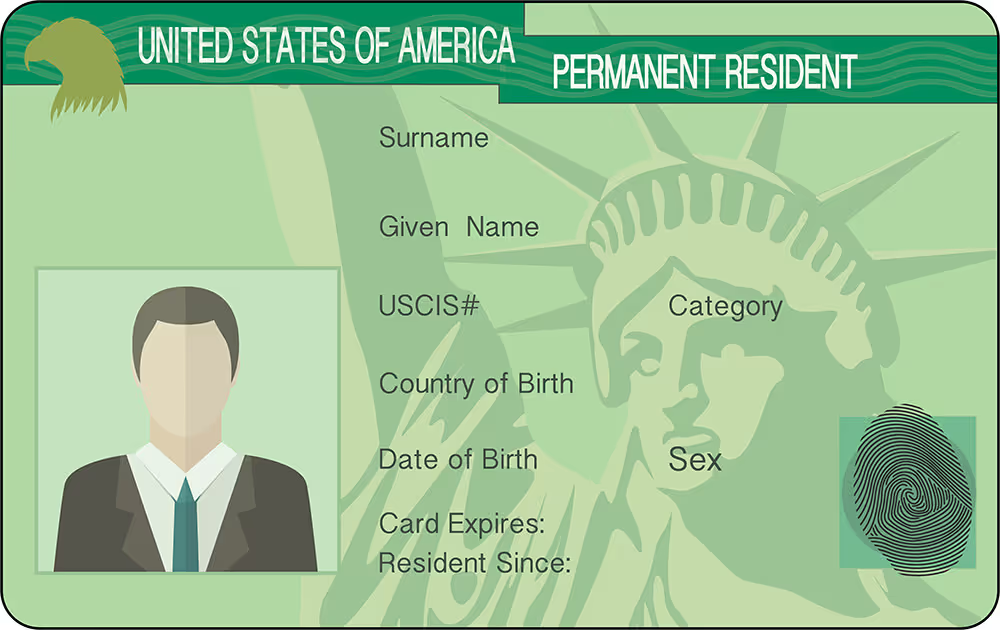
If you want to be able to make your permanent home in the United States, you'll need what is called "permanent residence," or a "green card." Green card holders can live and work in the U.S. and travel in and out, with very few restrictions (though they can't vote, and can be deported if they abuse their status).Family members of U.S. citizens make up the largest number of green cards issued each year. Others are issued to investors and workers who have been petitioned by U.S. employers or have special skills. Still other categories have a humanitarian basis, such as refugee or political asylum status (which can lead to a green card), for people who are fleeing persecution.
What is a Temporary (Nonimmigrant) Visa
People who want to come to the United States for a limited time need what is called a "nonimmigrant” visa. This lets them participate in specified activities (such as studying, visiting, or working) until their visa runs out. Students and businesspeople make up the largest groups of nonimmigrant visa holders. Nonimmigrant visas are also issued for tourists, exchange visitors, and workers with some kind of specialty that is lacking in the U.S. workforce. For more information, see
Exception: Visa Waiver Program
A visa is not necessary for short-term visitors from one of the Visa Waiver Program countries listed at http://travel.state.gov. You can come to the U.S. for up to 90 days for business or pleasure purposes if you're from one of these countries. You will, however, need to present a machine-readable passport. Also, beware: The ease of your entry is balanced by the ease with which you can be kicked out -- you automatically give up many rights and benefits when traveling without a visa.To enter on a visa waiver, simply present yourself, your passport, and your ticket home to the officers you'll meet upon arrival. If you come by land through Canada or Mexico, you'll also be asked for proof of sufficient funds to pay for your stay.
Applying for Immigration Rights
After figuring out what type of visa or green card you’re eligible for, you'll need to figure out how to get it. Most people (with the occasional exception of Mexicans and Canadians) must obtain a visa at a U.S. consulate before departing for the United States. If you’re already in the United States legally, you may be able to apply to “adjust" your status to permanent resident, or "change” your status to another type of visa.
Where to Find the U.S. Immigration Laws
Your possibilities for a visa or green card are set out under U.S. federal law. Being "federal," the law is the same across the United States, unlike state laws, which can vary by state. If you want to read the U.S. immigration laws -- which very few people actually want to do -- they’re found in Title 8 of the U.S. Code, or in the Immigration and Nationality Act (I.N.A.) In addition, information on how USCIS intends to carry out these laws is found at Title 8 of the Code of Federal Regulations (C.F.R.). The DOS regulations are at Title 22 of the C.F.R. The CFR can be searched at the Government Printing Office website.The trouble is that even lawyers have trouble researching the U.S. immigration laws -- they're considered to be the most convoluted and easily misunderstood portions of all U.S. law. But if you have a specific reference to a section that you'd like to read for yourself, by all means, look it up, then seek professional help if you need it.Your best bet for getting any professional help with your immigration situation is to hire an experienced immigration lawyer. Ask friends or local nonprofits for referrals or go to the website of the American Immigration Lawyers Association (AILA).Whatever you do, don't go straight to USCIS for advice. The people who staff their front desk are not all well trained, and if they give you wrong information, they take no responsibility, even if it causes your deportation or destroys your chances of immigrating. This happens!Many of these immigration laws are interpreted in U.S. Immigration Made Easy, by Attorney Ilona Bray (Nolo), including how to obtain many different visas, including the K-1 visa for fiancés, the B-1 and B-2 business and tourist visas, the H-1B, H-2B, and H-3 visas for temporary specialty or agricultural workers, the L-1 visa for intracompany transferees, the E-1 and E-2 visas for treaty traders and investors, the F-1 and M-1 visas for students, the J-1 visa for exchange visitors, or the O, P, or R visas for temporary workers, and how to get a green card through a family member, through the Diversity Visa Lottery, or as an asylee or refugee.
The Risks of Lying to the U.S. Government
One of the worst things you can do to your chances of getting a visa or green card is to lie, either on paper or during an interview with a U.S. border or other immigration inspector. Lies can have both immediate consequences, such as not being able to enter the U.S., and long-term consequences, such as not being able to get a green card -- ever.Example One:Francois, a French citizen, applies at the U.S. embassy in Paris for a tourist visa. He fears he will not be allowed to enter the U.S. as a tourist if he reveals that he has a girlfriend in New York. He states in his application that he will be visiting various friends. When he arrives at JFK Airport in New York, an immigration inspector finds a letter in his luggage from his girlfriend, in which she says she is looking forward to his long visit. Francois is put on the next flight home, and not allowed to return for five years.Example Two:Assume that Francois's immigration inspector does not find the letter from his girlfriend and allows him to enter the country. After he arrives, Francois and his girlfriend decide to marry. He files an application for permanent residence with USCIS. It forwards his application to the U.S. consulate in Paris for review. This reveals that he lied about his plans. To obtain permanent residence, Francois will have to argue that USCIS should overlook his previous lie and allow him to stay. If he loses, he can be denied permanent residence and forced to leave the country.
Who Can Be Kept Out
No matter what eligibility category you fall into -- whether you’ve married a U.S. citizen, received a job offer, or been accepted to a school -- the U.S. has the right to say no. And not just because there’s something wrong with your application. The immigration law contains a list of things, like crimes and certain diseases, that makes someone "inadmissible.” For more information, see When the U.S. Can Keep You Out.
How to Travel with a Green Card
A green card comes with several distinct benefits and rights as you settle into the United States.
Last Updated: October 19, 2021.
A green card comes with several distinct benefits and rights as you settle into the United States as your long-term home. After all, your permanent legal resident status allows you to live and work in the US, not to mention enjoy full protection under the laws of the nation.
But while these benefits are clear, something that remains unclear to many is whether or not you can travel with a green card and if so, what kinds of green card rules and limitations apply to travel. And if you’ve been wondering the same thing, you’ve landed on the right article.
At SimpleCitizen, our mission is to simplify every aspect of the green card process, including how to use your green card once you have it. In this article, we’ll discuss traveling outside the US with a green card, the documentation you will need, and how traveling abroad will affect your chances at naturalization. Let’s get started!
Can I Travel With a Green Card?
Of course you can! However, traveling with a green card requires certain documents and steps you must take to ensure you can return once your travels are complete.
There are two primary documents you will need to travel abroad:
1. Your Green Card and;
2. A passport from your country of citizenship or your refugee travel document permitting travel to the foreign country. Sometimes, countries require visas and as such, you must have this in hand as well for entry/exit purposes.
When you’re ready to return to the United States, you only need to present your valid green card, Form I-551, at the port of entry. Sometimes, officials will request to see your passport or other identifying documentation to grant you reentry into the country.
3. With COVID-19 still in full swing certain countries may have travel restrictions and COVID-19 vaccination requirements or require a negative COVID-19 test result. Be sure that you check the travel rules as you plan your trips to ensure you don't run into any issues getting in or out of the country.
What Steps Do I Need to Take Before Traveling?
If you’re planning on traveling abroad for less than one year, there are no additional steps you must take in preparation for your trip. In fact, all you need are the documents mentioned above to ensure you can leave and return to the US.
If you’re planning on traveling for more than one year, there are additional steps you must take before leaving the country. This is because you must demonstrate that you aren’t abandoning your permanent resident status and are planning to return to reside in the United States once again.
For Trips More Than One Year in Length
Should your trip be more than one year, it’s beneficial to file Form I-131, Application for Travel Document, prior to leaving. This Form allows a permanent resident to apply for a Reentry Permit for admission to the United States after returning from abroad. Doing so eliminates the need for a returning resident visa from a U.S. embassy or consulate and clarifies your intention to return to America after your travels.
Obtaining a Reentry Permit costs $360 plus a biometrics service fee of $85 if you are between the ages of 14 and 79, making the total fee $445. Please note that the Reentry Permit doesn’t guarantee your admittance to the country. While it will help, officials will also consider factors such as:
- Have you maintained family and community ties in the U.S. while abroad?
- Have you filed your U.S. income taxes as a resident?
- Have you maintained a U.S. mailing address?
- Do you have a valid driver’s license in the U.S.?
- Do you own property or run your own business in the U.S.?
- Have you applied for U.S. Citizenship?
Questions like these directly affect your chances of being allowed back into the country after a year abroad. Immigration officials are simply looking to see whether or not you still have the intention of living in the United States permanently.
For Trips More Than Two Years in Length
If you’re planning on remaining outside of the United States for more than two years, a Reentry Permit granted before your departure will no longer be valid when you return (these Permits are only valid for two years). As such, you should apply for a Returning Resident Visa, SB-1, at a U.S. Embassy or Consulate.
You should apply for this Visa at least three months in advance of your travel (or as soon as possible) to ensure it can be processed in time. To apply for the Visa, you will need:
- A completed Form DS-117, Application to Determine Returning Resident Status;
- Form I-551, Your Permanent Resident Card (green card);
- Your Reentry Permit (if you have obtained one);
- Dates of travel outside the US (airline tickets, passport stamps, etc.);
- Proof of ties to the United States (like those indicated in the section above); and
- Proof that your stay outside of the United States is for reasons beyond your control (medical reasons, employment with a U.S. company, etc.).
Obtaining this Visa will ensure that you can return to the United States after an extended stay abroad. While it is optional, you should consider it a necessity if you’re going to travel for more than two years.
Please note that there are exceptions for Visas and other documentation needs if you’re moving abroad with a spouse for a government job or military involvement.
Does Traveling Affect the Naturalization Process?
If you’re going to be outside of the United States for more than six months, you may affect requirements necessary for naturalization. In fact, there are green card rules for travel abroad. For example, you may not be allowed to travel abroad if you haven’t been physically present in the country for at least 30 months out of the previous five years. This is an example of continuous residency requirements.
Should you not meet requirements like this, you may still be eligible for naturalization. You will need to take additional steps to prove that abandonment wasn’t an abandonment of your resident status to ensure you can remain on the path to citizenship.
If your trip must be more than six months, you may choose to file Form N-470, Application to Preserve Residence for Naturalization Purposes. This is only available to legal permanent residents looking to leave the United States for employment purposes. The Form costs $330 to file. If you’re unable to pay this fee, you may submit Form I-912 with your application for a fee waiver request.
Simplify Your Travel Abroad With SimpleCitizen
The team at SimpleCitizen believes that your experience living in the United States shouldn’t be complicated. Likewise, you should be able to travel abroad while retaining your legal permanent status. For that reason, we hope you find this article helpful with the information you need to travel with peace of mind.
Want to Learn More About Traveling Abroad?
If you’re looking to learn more about international travel with a green card, check out the links below!
USCIS: International Travel as a Permanent Resident
USCIS: Maintaining Permanent Residency
Form I-131, Application for Travel Document
Form N-470, Application to Preserve Residence for Naturalization Purposes
Is a J-1 Visa Holder Eligible to apply for a Green Card?
Here you can learn more about obtaining the J-1 Visa and other relevant visas.
Last Updated: October 19, 2021.
J-1 Exchange Visitor Visa
The Exchange Visitor (J) non-immigrant visa category is for individuals approved to participate in work-and study-based exchange visitor programs. Participants are integral to the success of the program. Here you can learn more about obtaining the J-1 Visa and other relevant visas.
Yes, a J-1 visa holder can be eligible for a green card.
To obtain a green card, the immigrant must first file a petition I-140 with the USCIS. After this, it is essential to apply for an Adjustment of Status (AOS) or for an immigrant visa. If the immigrant resides in the U.S., they should use an AOS application. If the immigrant lives in a foreign country, they need to apply for an immigrant visa.In-order to apply for immigrant status, you can consider any one of the following options:
- Family based immigration: A petition can be filed by your relatives who are U.S citizens or permanent residents of the U.S.
- Employment based immigration: In this case, you must find an employer who will file a labor certificate at the DOL for you.
- EB-1: Based on the classification of EB-1A “immigrant of extraordinary ability” or EB-1B “outstanding professor or researcher,” you can file an immigrant petition.
- National interest waiver: There are certain waivers available to individuals who can prove themselves as “immigrants of extraordinary ability.” Waivers are also available to individuals seeking opportunities to work in the U.S. These waivers are called national interest waivers. Filing an immigration petition through the national interest waiver can help you obtain immigrant status.
Petitions for green cards can be filed at any time, even if the individual is subject to the requirement to reside outside of the U.S. for a period of two years. The individual must satisfy the two-year foreign residency requirement after the petition has been approved. A waiver can be obtained for the foreign residency requirement, in which case the individual need not move to the home country.[eligibility-quiz-green-card]
Who Can File Form I-130?
Understanding who can file Form I-130 and who they can file it for.
There is a difference between U.S. Citizens and lawful permanent residents (meaning residents with green cards) when it comes to who you may file Form I-130 for. If you are a United States citizen you may file Form I-130 for numerous relatives, including
- Your spouse
- Your unmarried child under age 21
- Your unmarried son or daughter age 21 or older
- Your married son or daughter of any age
- Your brother(s) or sister(s) if you are 21 or older; and
- Your mother or father if you are 21 or older.
However, if you’re a lawful permanent resident you may only file the Form for:
- Your spouse
- Your unmarried child under age 21; and
- Your unmarried son or daughter age 21 or older.
If you want to file for more than one relative, you must complete a separate Form I-130 for each individual. There is no limit to the number of forms you can submit as long as each relative fits into the categories listed under “citizen” or “lawful permanent resident” above.
Perhaps it may be found within a different category.